
Started August 2016 | last updated May 2025 | 1,000 words | Contents
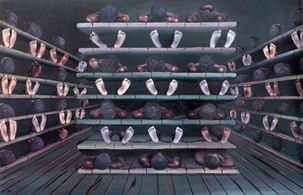
European colonialism fucked up the whole world in many ways. But by far the worst thing was the Atlantic slave trade and slavery in the Americas. That terrible crime remains unresolved. Its aftermath blights the lives of millions of black people living in the US, the UK and elsewhere.
This is a standalone version of a section in my post Racism explained – as a redundant instinct.
The slave trade and slavery in the Americas
Top 🔼
Contents
The slave trade and slavery in the Americas
Introduction
The misery of slavery has, of course, existed in nearly every culture, nationality, and religion from ancient times to the present day – with or without any ‘justification’.
Estimates of the number of modern slaves range from 21 to 46 million. Perhaps this shows humans have an innate capacity to see certain ‘categories’ of our fellow humans as ‘other‘.
Slavery is thought to have been rare amongst hunter-gatherer populations. It really took off after the invention of agriculture about 11,000 years ago.
Perhaps hunting and gathering was an interesting and sociable activity, whereas farming was boring and tedious. Perhaps thoughts turned to how to get someone else to do it for you, preferably for free.
Farming led to city states, which led to warfare and captive slaves (and which later led to capitalism and wage slavery). Bingo!
The Bible condones slavery. Its purported moral superiority was wielded by cynical colonialists and deluded missionaries to replace indigenous culture, but the ‘Good Book’ wasn’t so good. It blithely accepted the fundamentally immoral practice of slavery.
In the Old Testament, check the terms and conditions that follow the Ten Commandments. In Exodus 21:26, slavery is clearly accepted as perfectly normal.
The New Testament continues to accept slavery. For instance, in Ephesians 6:5, the letter writer, possibly Paul, urges slaves to obey their masters.
Jesus’s powerful message of meekness triumphant was cynically exploited by colonialist Christian missionaries to encourage African acceptance of the European occupation – and of slavery in the Americas.
What would Jesus – apparently a real person and a radical teacher – think of such wickedness done in his name? (He said, Give to Caesar what belongs to Caesar, but that was coming from an occupied Jew, not from an imperialist Roman.)
The much-romanticised Anglo-Saxon age in Britain (I’m British – Hi) featured slavery, known as chattel slavery. Norman invader William the Conqueror is rightly hated for his legacy of land-grabbing aristocracy – see my post, The super-rich – law and order – but he did at least one good thing: he ended chattel slavery.
The slave trade and slavery in the Americas
What white people did
Four hundred years after the end of Saxon chattel slavery, European colonialists reinvented slavery. Bolstered by ideological racism, they latched onto existing African slavery systems and created the massive Atlantic slave trade, thereby instituting a whole new level of organised vicious inhumanity.
An estimated 12 million slaves were forced into the Atlantic trade between the 16th and 19th centuries. About four million died in Africa after capture, 1.5 million died on board ships, and 10.5 million reached the Americas to work on plantations.
The death rate on plantations was high, a result of overwork, poor nutrition and work conditions, brutality and disease. Many plantation owners preferred to import new slaves rather than provide the means and conditions for the survival of their existing slaves.
Kindness and conscience eventually prevailed. Opposition to slavery and to the slave trade began in the 1770s. The abolition of slavery was completed in the Caribbean by 1850; and in the US by 1865.
The slave trade and slavery in the Americas
After slavery
The US didn’t compensate the ‘owners’ of enslaved people, but the British did. Disgustingly, the 1833 Slavery Abolition Act required British ‘owners’ to be compensated.
The UK government borrowed £20m, equivalent today to £17bn. (It took until 2015 to complete the loan repayment.) 47,000 ‘owners’ got compensation.
No money and no apology has ever been given by the UK or the US to the enslaved people or their descendants.
As well as compensating ‘owners’, Britain managed to continue the racist brutality. Instead of being freed, enslaved people under British rule were forced to continue their slavery for four more years in the name of ‘apprenticeship‘.
Under the ‘apprenticeship’ regime, the brutal punishment for working too slowly or taking time off included being hung by the hands from a plank and forced to ‘dance’ a treadmill.
America the Beautiful is scarred by its ugly legacy of slavery. Sixty years after the achievements of the civil rights movement, the African American minority continues to face systemic and personal discrimination and prejudice.
The legacy of slavery wasn’t quite so bad in the Caribbean. After abolition, former slaves were in the majority in the islands, and, after independence – achieved between 1962 (Jamaica, Trinidad and Tobago) and 1983 (St Kitts and Nevis) – their descendants went on to assume power.
However, the UK African Caribbean minority – those who migrated to the UK in the 1950s and 60s and their descendants living in the UK – have faced, like the African American minority, prejudice and disadvantage due in part to the legacy of slavery.
The slave trade and slavery in the Americas
No compensation
The profits from slavery created vast wealth for white UK and US ‘owners’ of enslaved people. None of the perpetrators of that vile crime were held to account – and none of the proceeds were confiscated.
On the contrary, the UK government compensated the perpetrators and profiteers. 47.000 (47. Thousand) UK ‘owners’ of enslaved people were compensated for their ‘loss’. The government took out a massive loan and gave each ‘owner’, on average, about £400,000 by today’s values.
The African enslaved people were given nothing by the UK or the US – except, in the case of US freed people, the famous broken promise of forty acres and a mule.
The German government has rightly paid over $90bn in compensation to the Holocaust survivors and the victims’ heirs.
But there’s a shameful lack of any equivalent compensation paid to the heirs of the victims of the Atlantic slave trade and slavery in the Americas by the governments that permitted, colluded with, perpetrated and profited from those terrible crimes.
The descendants of enslaved people have been given nothing except the after-effect of slavery: devastating personal and institutional postcolonial racism.
Black descendants of of the victims of slavery understandably resist being seen wholly as victims themselves because it undermines their fight against racism. Nevertheless, they are victims – of post-slavery racism. As such, they’re entitled by natural justice to compensation.
But that same racism, disguised as fiscal caution, means that, sadly, it’s not going to happen.
The End
 soothfairy