at fifty-five, Larkin leaked
his early-morning fear of death
at thirty-three, Thomas told
his dying dad to rage
both too young for the animal dread –
and the need to act your age
life’s a bowl of cherries
it’s also a bowl of crap
it’s a cabaret, a revolving door
a way marked on a map
but after threescore years and ten
the end is feeling real
and whatever life is, you want more
to stem the fear you feel
well tough, too bad, you greedy old git
your lust for life’s a bit obscene
death is coming – let it come
you can blame the selfish gene
act your age, turn the page
do some meditation
follow your breath, accept that Death
will need no invitation
Mother Nature doesn’t care
now you’re past the age of mating
so – what comes next?
you might well ask
to pass the time of waiting
free-verse main
what comes next? nothing, say devout atheists something, say practical mystics and
unbelievable believers i don’t know, say we wishy-washy agnostics
no one really knows
which should put nothing in the lead
but many near-death day-trippers say
there’s something coming next
consciousness being unexplained
and perhaps in a separate field
my money’s on something to win
but will it be something good
or will it be something bad?
a Heaven of wonderful meaning
or a Hell of meaningless dreams?
i pray to Om for meaning
for meaning after death
but Great God Om is silent
he’s on a toilet break, the total fake
my unanswered prayer
goes drifting into space
i can only speculate
something scenario 1: dreaming
dreaming after death
the scariest scenario
my living dreams are confused,
unhappy and meaningless
i fear an eternity of that
i add to my my to-do list
practice lucid dreaming
something scenario 2: judgement
on the day of judgement at the crossroads
with St Peter, the Devil
and Robert Johnson watching on
a ghostly AI does the dirty work
sifting swiftly through my life
the result isn’t great
what d’you say? says Johnson
in a kindly kind of way
i say i’m sorry
for not making the most of it
and being a shit sometimes
it wasn’t my fault, give me a break, i whine
then pulling what’s left of myself together
i say whatever, do it
and my judged afterlife begins
something scenario 3: quantum reality
so obviously the multiverse
being made of consciousness
and everything being an illusion, kind of
and my consciousness being a durable
construct of quantum reality
i survive death
with a body made of quantum magic
mine but young and healthy
i see the light, dead friends and relatives
maybe Baby Jesus and Santa Claus
another illusion? perhaps
but it’s better than instant nothing
isn’t it?
quantum scenario 1: reincarnation
after a while,
in the reincarnation unit
surrounded by the spirits of
my surviving loved ones (if any)
and maybe an angel or two
my soul is stripped down
to its unique quantum core
and reborn
(preferably as a human for fuck’s sake)
hello again!
additional souls for the increasing population are presumably made from scratch
quantum scenario 2: reabsorption
after a (different) while,
in the reabsorption unit
(watched again by loved ones and angels)
i dissolve into the ocean of quant
bye bye!
quantum scenario 3: freedom!
after a (short) while
i join a rebel group
we escape from Heaven
in a scifi-action-movie kind of way
and roam the quantum multiverse
on a quest for cosmic justice
like Roy Batty and Gilgamesh
we’re going to meet our maker
whoopee!
other quantum scenarios may be available
or there’s nothing
brain shuts down, mind fades fast
never mind, i think
it was never going to…
Editors’s note: This poem was smuggled out of a high-security asylum for the insane somewhere in the Austrian Alps. Brucciani is thought to have overdosed on scopolamine whilst serving as poet in residence at the Sigmund Freud Museum. The Society of Poets is said to be organising a rescue mission.
Started August 2016 | last updated May 2025 | 1,000 words | Contents
European colonialism fucked up the whole world in many ways. But by far the worst thing was the Atlantic slave trade and slavery in the Americas. That terrible crime remains unresolved. Its aftermath blights the lives of millions of black people living in the US, the UK and elsewhere.
The misery of slavery has, of course, existed in nearly every culture, nationality, and religion from ancient times to the present day – with or without any ‘justification’.
Estimates of the number of modern slaves range from 21 to 46 million. Perhaps this shows humans have an innate capacity to see certain ‘categories’ of our fellow humans as ‘other‘.
Slavery is thought to have been rare amongst hunter-gatherer populations. It really took off after the invention of agriculture about 11,000 years ago.
Perhaps hunting and gathering was an interesting and sociable activity, whereas farming was boring and tedious. Perhaps thoughts turned to how to get someone else to do it for you, preferably for free.
Farming led to city states, which led to warfare and captive slaves (and which later led to capitalism and wage slavery). Bingo!
The Bible condones slavery. Its purported moral superiority was wielded by cynical colonialists and deluded missionaries to replace indigenous culture, but the ‘Good Book’ wasn’t so good. It blithely accepted the fundamentally immoral practice of slavery.
In the Old Testament, check the terms and conditions that follow the Ten Commandments. In Exodus 21:26, slavery is clearly accepted as perfectly normal.
The New Testament continues to accept slavery. For instance, in Ephesians 6:5, the letter writer, possibly Paul, urges slaves to obey their masters.
Jesus’s powerful message of meekness triumphant was cynically exploited by colonialist Christian missionaries to encourage African acceptance of the European occupation – and of slavery in the Americas.
What would Jesus – apparently a real person and a radical teacher – think of such wickedness done in his name? (He said, Give to Caesar what belongs to Caesar, but that was coming from an occupied Jew, not from an imperialist Roman.)
The much-romanticised Anglo-Saxon age in Britain (I’m British – Hi) featured slavery, known as chattel slavery. Norman invader William the Conqueror is rightly hated for his legacy of land-grabbing aristocracy – see my post, The super-rich – law and order – but he did at least one good thing: he ended chattel slavery.
Four hundred years after the end of Saxon chattel slavery, European colonialists reinvented slavery. Bolstered by ideological racism, they latched onto existing African slavery systems and created the massive Atlantic slave trade, thereby instituting a whole new level of organised vicious inhumanity.
An estimated 12 million slaves were forced into the Atlantic trade between the 16th and 19th centuries. About four million died in Africa after capture, 1.5 million died on board ships, and 10.5 million reached the Americas to work on plantations.
The death rate on plantations was high, a result of overwork, poor nutrition and work conditions, brutality and disease. Many plantation owners preferred to import new slaves rather than provide the means and conditions for the survival of their existing slaves.
Kindness and conscience eventually prevailed. Opposition to slavery and to the slave trade began in the 1770s. The abolition of slavery was completed in the Caribbean by 1850; and in the US by 1865.
The US didn’t compensate the ‘owners’ of enslaved people, but the British did. Disgustingly, the 1833 Slavery Abolition Act required British ‘owners’ to be compensated.
The UK government borrowed £20m, equivalent today to £17bn. (It took until 2015 to complete the loan repayment.) 47,000 ‘owners’ got compensation.
No money and no apology has ever been given by the UK or the US to the enslaved people or their descendants.
As well as compensating ‘owners’, Britain managed to continue the racist brutality. Instead of being freed, enslaved people under British rule were forced to continue their slavery for four more years in the name of ‘apprenticeship‘.
Under the ‘apprenticeship’ regime, the brutal punishment for working too slowly or taking time off included being hung by the hands from a plank and forced to ‘dance’ a treadmill.
The legacy of slavery wasn’t quite so bad in the Caribbean. After abolition, former slaves were in the majority in the islands, and, after independence – achieved between 1962 (Jamaica, Trinidad and Tobago) and 1983 (St Kitts and Nevis) – their descendants went on to assume power.
However, the UK African Caribbean minority – those who migrated to the UK in the 1950s and 60s and their descendants living in the UK – have faced, like the African American minority, prejudice and disadvantage due in part to the legacy of slavery.
The profits from slavery created vast wealth for white UK and US ‘owners’ of enslaved people. None of the perpetrators of that vile crime were held to account – and none of the proceeds were confiscated.
On the contrary, the UK governmentcompensated the perpetrators and profiteers. 47.000 (47. Thousand) UK ‘owners’ of enslaved people were compensated for their ‘loss’. The government took out a massive loan and gave each ‘owner’, on average, about £400,000 by today’s values.
The African enslaved people were given nothing by the UK or the US – except, in the case of US freed people, the famous broken promise of forty acres and a mule.
The German government has rightly paid over $90bn in compensation to the Holocaust survivors and the victims’ heirs.
But there’s a shameful lack of any equivalent compensation paid to the heirs of the victims of the Atlantic slave trade and slavery in the Americas by the governments that permitted, colluded with, perpetrated and profited from those terrible crimes.
The descendants of enslaved people have been given nothing except the after-effect of slavery: devastating personal and institutional postcolonial racism.
Black descendants of of the victims of slavery understandably resist being seen wholly as victims themselves because it undermines their fight against racism. Nevertheless, they are victims – of post-slavery racism. As such, they’re entitled by natural justice to compensation.
But that same racism, disguised as fiscal caution, means that, sadly, it’s not going to happen.
Bad trip or what? | Photo: Ken Russell/Altered States
A 2016 UK Guardian article about films that show how the mind works included an analysis of Ken Russell’s Altered States by radical psychologist Sue Blackmore. She said there isn’t really a ‘hard problem of consciousness’*. She said that ‘somehow’, we should see the mind and brain as the same thing.
If we’re allowed to think that something might ‘somehow’ be true, we might also consider the possibility suggested by radical biologist Rupert Sheldrake: that the brain is a receiver for consciousness, which – somehow – exists outside it.
(Sheldrake is written off as “woo” by some, but for those who bother to read him he makes a good case.)
* The hard problem of consciousness The name given in neuroscience / consciousness studies to the unsolved problem of how and why sensations acquire characteristics, such as colours and tastes. (See, for instance, this Guardian article on the subject.)
Postscript I emailed Sue Blackmore and she kindly replied. Her reply showed she’s dedicated to opposing the duality that sees consciousness as something separate. Sadly, she doesn’t think much of Sheldrake’s ideas. (Perhaps some radicals, ploughing their lone furrows and perhaps secretly yearning for the mainstream, don’t like to be associated with other radicals. Perhaps.)
The murder of six million Jews by Nazi Germany, known as the Holocaust, is hard to contemplate. But it resonates – as it should – in our collective memory.
Started August 2016 | last updated May 2025 | 1,700 words | Contents
There’s been anti-Jewish racism since the Jews’ most recent exile from Israel by the Roman empire, and their consequent dispersion throughout Europe.
Exile and diaspora is the conventional narrative – but apparently it’s more complicated than that. Apparently, historically, there was no expulsion two thousand years ago.
But however it came about, Jewish diaspora communities lived in Europe. They lived mainly in productive harmony with host communities, but cynical anti-Jewish rabble-rousing led to outbreaks of racist violence, or ‘pogroms‘; and Christian and Muslim extremism led to persecution and expulsion.
The Granada massacre of 1066, a Muslim pogrom in which approximately 4,000 Jews were killed, marked the end of centuries of peaceful coexistence with a liberal Muslim regime in Spain.
The final Christian reconquest of Spain in the late 1400s led to approximately 2,000 Jews being murdered by the Spanish Inquisition and to the eventual expulsion from Spain of over 50,000 Jews.
Savage pogroms continued all over Europe until as recently as the 1940s.
16th-century Christianity reformer Martin Luther publicly recommended the burning of synagogues. Protestant Luther’s beef with Judaism was supposedly theological – but his bitter hatred betrays something less ethereal.
Reformer and anti-Jewish racist Martin Luther | Painting: Lucas Cranach the Elder
(Ironically, Luther’s modern namesake, Protestant minister and black civil rights leader Martin Luther King, publicly spoke out against black anti-Judaism. He acknowledged Jewish participation in the civil rights movement and he actively – controversially – supported the state of Israel.)
Encouraged by the original Luther’s widely disseminated anti-Jewish rhetoric, 19th-century German ‘race’ theorists and philosophers ramped up the anti-Judaism.
The 19th-century German ‘race’ theorists invented the pseudoscientific word ‘antisemitic’. (See my post about that ridiculous word for a tragic phenomenon, Antisemitism – anti-what??)
German philosopher Friedrich Nietzsche is often accused of anti-Judaism. However, that reputation was created by his sister Elizabeth Förster-Nietzsche, who edited his works after his mental breakdown in 1889 and his death in 1900.
Nietzsche’s sister systematically falsified his writings to match her own virulent anti-Jewish racism. Nietzsche was arguably a protofascist, but he was deeply contemptuous of anti-Judaism and nationalism.
Förster-Nietzsche’s falsifications have since been corrected, but they were current in the 1920s and 30s. The main fakery was in Förster-Nietzsche’s collection of her late brother’s notes, published in 1906 as a book, The Will to Power.
Luther and Förster-Nietzsche were perpetuating derogatory stereotypes of Jews common in Europe for centuries, as exemplified in literature by Shakespeare’s Shylock and Dickens’s Fagin.
For instance, the ‘blood libel’ was a widespread anti-Jewish slur which – ridiculously – accused Jews of murdering Christian children to use their blood in the baking of Passover bread.
Such stereotypes found ultimate expression in the fake but influential 1903 document, The Protocols of The Elders of Zion, which purported to reveal – in great detail – a Jewish plot for world domination.
The Protocols of The Elders of Zion was exposed as totally fraudulent in the early 1920s, but it was taught as factual to schoolchildren in 1930s Nazi Germany. It’s still touted around amongst modern conspiracy theory enthusiasts. (David Icke thinks the ‘Elders of Zion’ are extradimensional beings.) Anti-Jewish prejudice, unlike most other forms of racism, isn’t colour prejudice. It’s not a reaction to people’s skin colour – it’s white-on-white prejudice.
As with Islam, Judaism is a religion, not a ‘race’. But, although Judaism contains different ethnic strands, the European Jewish diaspora can be said to be a ‘population’, like African or South Asian people. In the social construct sense, they’re a ‘race’. But they’re not a population easily identifiable by appearance. So how does the prejudice arise?
Anti-Jewish prejudice must be a form of culturist racism: specifically – historically – prejudice against the Jewish diaspora, where people of a different culture came to live in or near a settled neighbourhood, not as individuals but as a self-contained community.
Such Jewish diaspora groups arrived at established communities throughout Europe as fringe communities. Romani travellers, also known as Gypsies, who kept moving rather than settling, were similarly outsiders – and were similarly wiped out in the Holocaust.
Jews – like Gypsies – are voluntarily outsiders, not wanting to integrate but keeping to themselves and to their own culture. This marks them out for prejudice – in that being different means being seen as a threat.
The cultural differences are actually harmless – Jews aren’t actually plotting to rule the world – it’s the difference itself that causes fear, probably mainly unconsciously, which manifests as racism.
Culturism, of course, works one way. Racism is power plus prejudice, so the power is with the European majority and the prejudice is against the outsider minority.
(Culturism, as well as underlying white-on-white anti-Judaism, probably also boosts white-on-black colour prejudice, in that a different skin colour indicates a different culture.)
European anti-Judaism climaxed in the 1940s in Nazi Germany with the Holocaust, Adolf Hitler’s insane, genocidal ‘final solution to the Jewish question’.
Hitler’s anti-Jewish fascism was boosted by:
Widespread, centuries-old European anti-Jewish stereotypes and culturist racism
The anti-Jewish writings of German uber-Protestant Martin Luther
Racist 19th-century German pseudoscientific ‘race’ theory
The protofascist ‘übermensch‘ writings of German philosopher Friedrich Nietzsche
The anti-Jewish falsifications by Nietzsche’s fascist sister, Elizabeth Förster-Nietzsche in his posthumous book, The Will to Power.
Racist, pseudoscientific US eugenics programmes funded by the Carnegie Institution, the Rockefeller Foundation and John Kellogg.
Nazi Germany’s increasingly brutal 1930s anti-Jewish campaign ended in genocide when Jews were sent to extermination camps. In the death camps, the German state systematically murdered six million Jews.
Between 150,000 and 1.5 million Romani people were also murdered by the state.
For those of us who oppose racist anti-Judaism, the Holocaust’s meticulously organised murder of six million Jews haunts our imagination. It’s difficult to understand how people could have done that.
In 1961 the trial of high-ranking Nazi Adolph Eichmann took place in Israel. Eichmann, who’d been instrumental in organising the Holocaust, famously said he’d merely obeyed orders.
Yale professor Stanley Milgram, a US Jewish social psychologist, heard about Eichmann’s defence and posed this question:
What is there in human nature that allows an individual to act without any restraints whatsoever, so that he can act inhumanely, harshly, severely, and in no ways limited by feelings of compassion or conscience? My bolding
Milgram then conducted a famous and controversial series of ingenious experiments – with shocking results.
Milgram showed that ordinary people in thrall to white-coated authority figures were willing to inflict what they believed to be severe pain and even death on strangers. (The strangers were played by actors.)
Questions have understandably been raised about the ethics and methodology of Milgram’s experiments. Their relevance to the Holocaust has been questioned. But Milgram’s basic findings still hold true.
The Holocaust authority figures themselves must have had some form of empathy-deficient mental disorder such as psychopathy. But more disturbingly, ordinary people in that situation were able to set aside their empathy.
Perhaps, however, the Holocaust executioners were not only acting in innate obedience to authority figures, as suggested by Milgram’s experiments, but were also indulging an instinctive racist urge.
Ironically, extreme nationalism – a main factor in the Holocaust – is now a charge made against the powerful US-backed state of Israel in its ongoing conflict with Palestinian people, many of whom were expelled from their homes and homeland during the controversial establishment of Israel which began in 1948.
Equally ironically, the number of Palestinian people registered as refugees (in 2025) is six million. (There are about seven million Jewish people living in Israel.)
Following an attack on Israel in October 2023 by Hamas, the militant group running the Palestinian Gaza Strip, Israel launched the one-sided Gaza ‘war’ against Hamas during which many tens of thousands of Palestinian civilians, including children, have been killed or seriously injured by the IDF – the Israeli ‘defence’ forces.
Mahmoud Ajjour, nine, lost both arms during an Israeli attack on Gaza City | Photo: Samar Abu Elouf / New York Times
The International Criminal Court (ICC) accused the Israeli premier of war crimes and crimes against humanity, and – in the final irony – Israel was accused of genocide.
Supporters of the Palestinian cause who criticise Israeli Zionism are accused (perhaps correctly in some cases) of anti-Jewish racism. And so it goes.
A Sephardi (Jews of North African origin) chief rabbi reportedly said there could be no explanation other than ‘pure racism’.
Outside Israel, despite the terrible lesson of the Holocaust, anti-Judaism continues to thrive.
A 2008report by the US department of state found there was an increase in anti-Judaism across the world, and both old and new expressions of anti-Judaism persisted.
A 2012report by the US bureau of democracy, human rights and labor noted a continued global increase in anti-Judaism, and found Holocaust denial and opposition to Israeli policy were used to promote or justify anti-Judaism.
The German government has paid over $90bn in compensation to the victims and survivors of the Holocaust and their heirs.
Cosmic architect Yin was in bad mood. Something had gone wrong. Yin had picked a universe, found a suitable planet, added a moon, seeded life, guided evolution by wiping out the dinosaurs (with, Yin smugly recalled, a well-aimed asteroid), and now, after four billion planet years (no time at all, really) the sodding superconscious beings were about to destroy their environment!
Reason had replaced religion, so further intervention was out – free will was essential. It was tempting to smite that ‘drill, Baby, drill’ fool, but it was a free and fair election, so… The short life span didn’t help. Yin felt bad about that, but it was what happened with evolution. Apparently.
The angels would try to help, but it wasn’t looking good. Another singularity project down the drain, thought Yin. The same thing, or similar, was happening in innumerable universes. Oh well, fuck it, thought Yin. Plenty more fish in the sea.
Black and South Asian postwar immigrants to the UK and their descendants are often asked ‘Where are you from?’ – a question loaded with a queasy mixture of idle curiosity and unconscious or semiconscious racism.
Begun 2019 | Revised 2025 | 1,300 words | Contents
How should they respond to that loaded question? It’s a minefield.
For a white Briton like me, asking that question of a brown or blackBriton who’s a stranger or casual acquaintance is a bad idea. Much worse is asking as a follow-up question:
Where are you really from?
Such questions are inconsiderately intrusive and, at best, microracist. Unpicked – though the questioner might not consciously realise it – the question is likely to mean:
Your skin colour and facial appearance suggests your ethnic origin isn’t north European. In which country are your family origins? Actually, though, I don’t really care where you’re from. My question is mainly rhetorical and microracist. I’m really just drawing attention to your otherness.
A 2022 high-profile incident at a charity reception involving a UK royal aide, ‘Lady’ Susan Hussey, and a black British charity worker, Ngozi Fulani, is a good example of this phenomenon.
Hussey questioned Fulani’s origins, repeatedly asking where she was ‘really’ from. This was witnessed by several other people and reported by Fulani on
social media.
Former royal aide Susan Hussey | Photo: Getty
‘Lady’ Hussey – daughter of the 12th ‘Earl’ Waldegrave, widow of former BBC chairman and life peer ‘Baron’ Hussey, godmother to heir ‘Prince’ William, and a close friend of ‘King’ Charles, ‘Queen’ Camilla and the late ‘Queen’ Elizabeth – resigned after the incident.
At an arranged meeting two weeks later in Buckingham Palace, Hussey apologised to Fulani, and Fulani accepted Hussey’s apology.
However, in spite of that stage-managed resolution, the unpleasant incident supports Meghan Markle’s implied claim of racism in the royal household; and implies widespread casual racism amongst the ruling class.
If the question, as in that case, seems offensively rhetorical, the asker’s bluff can be called: ‘Why do you want to know?’
If the question seems genuine, and worthy of a helpful response, it might nevertheless be not so easy to answer.
For an answer to be accurate – and understood – both parties need good geopolitical and historical awareness. It can get complicated.
For instance, If a British person of South Asian appearance is known to be a Muslim, they might not be – as might be assumed – of Pakistani or Bangladeshi origin. Many UK Muslims have origins in the Indian state of Gujerat. (Almost 20 percent of Indian people are Muslims.)
Many South Asian people came to the UK from Kenya and Uganda. South Asian communities were established beforepartition in East Africa and the Caribbean, mainly in Kenya, Uganda and Trinidad. They were there because of another piece of clumsy and careless social engineering by the Brutish Empire:indentured servitude.
Following the ending of slavery, between 1834 and 1917, many people were induced to move from India to other colonies as indentured labourers for the empire. Unsurprisingly, the conditions were harsh and the wages low. The workers were derogatively called ‘coolies’.
Indian indentured labourers, seeking to escape the poverty and famine frequent during colonial rule, came mainly from the Punjab and Bengal regions (both later severed during partition).
On completing their indenture, some Indian people stayed on in Africa or the Caribbean. They were joined by family members and formed thriving expatriate communities, albeit protected by the brutal stranglehold of empire.
After those colonies gained independence, many South Asian residents moved to the UK. Those in Uganda were famously expelled by Idi Amin. In Kenya, harsh changes to citizenship rules prompted mass voluntary emigration.
Those UK immigrants, whilst identifying by religion, often also identify by their diaspora community. For instance, people may identify as Kenyan Muslims.
My South Asian Muslim wife, when asked ‘Where are you from?’, sometimes says ‘Nairobi’. Her ethnicity is Punjabi but she was born in Kenya and spent her childhood there.
The person asked that question could give an informative reply, such as:
My family origins are Punjabi Muslim in what’s now Pakistan. In the late 1800s my grandfather went from the Punjab to work in what’s now Kenya. Our family lived there before coming to the UK in the late 1960s.
They could summarise it: ‘Pakistan’. But the question is more likely to provoke a passive-aggressive and deliberately obtuse reply, such as, ‘I’m from Leicester – where are you from?’ (or the deliberately annoying ‘from my mother’s womb’).
The hidden question, ‘Why are you here?’ at least offers the possibility of debate and reason; but behind that lurks the racist rhetorical question:
Why don’t you go back there?
For postwar immigrants to the UK and their descendants, such racism is never far below the surface.
Note: My post Racism explained as a redundant instinct suggests racism is a redundant anti-stranger instinct revived and twisted by colonialism and postcolonialism – and, sadly, provoked by the postwar mass immigration carelessly engineered by a patrician government. We anti-racists choose to reject and oppose that twisted impulse and to embrace our brilliant multicultural society.
Thoughtful white Brits aware of all that – or just wary of the social minefield – don’t ask that awkward, loaded question. But it does get asked.
If I was a British person of colour asked by a white person, ‘Where are you from?’, and the question seemed intrusive, I’d want to challenge it, but it in a non-hostile way.
I’d initially bat it back by – politely – saying, ‘How do you mean?’ If they indicated they were asking about my ethnic origin rather than my place of residence, I’d ask – still politely, if possible:
Why do you want to know?
The questioner might well find it difficult to explain themselves. Serves them right.
British people of colour people also ask the question, ‘Where are you from?’ of each other. The purpose is to find out the other’s origins: country, religion, region, town, caste, class, whatever.
That’s a different can of worms – and it doesn’t excuse white Brits asking that question. As always, context is crucial. The context is the white west and – as always – racism is prejudice plus power.
Osler takes the question seriously, exploring her complex Empireland* family heritage, but she starts by explaining how that question can undermine one’s sense of belonging and nationality with its implied accusation:
You don’t belong here – you’re not British
Clearly, not everyone asking that question is aware of the toxic smog it stirs up – but ignorance is no excuse. Osler suggests a barbed comeback: having answered (or not answered) the question, turn it around and ask:
Where are you from?
* Note: The resonant name Empireland was used by award-winning British journalist Sathnam Sanghera as the title of his 2021 best-selling book, which shows how the Brutish Empire shaped modern Britain but has been airbrushed out of cultural awareness and is barely even taught in schools.
It’s suggested life somehow developed by means of a series of random chemical interactions – but that’s implausible. Super-complex DNA must have been designed.
During a recent UK BBC Radio 4 discussion, a top scientist working on the origin of DNA (deoxyribonucleic acid), the source of all life, suggested it ‘somehow’ resulted from random chemical interactions of increasing complexity. The scientist’s ‘somehow’ said it all – the suggestion is implausible.
As biochemistry’s understanding of the mind-boggling complexity of DNA has proceeded, so understanding of its origins has receeded.
It’s normal for scientists to fudge this issue. For instance, Prof Brian Cox, the well-known UK physicist and TV science promoter, says:
On our planet we have seen active geology encourage carbon atoms to form into long chain molecules that encode information.
Cox is wrong to imply the formation of DNA is understood. Despite many years of experimental research, all we’ve actually seen is biochemists offering implausible and unproved theories.
Wikipedia’s entry on abiogenesis (the study of how life originated) duly relates the various theories, but says:
…the transition of non-life to life has never been observed experimentally, nor has there been a satisfactory chemical explanation.
Quite so. Without the post-DNA driving force of natural selection, there’s no way random chemical interactions could have gradually increased in complexity to the point of – somehow – ending up as the massively complex, self-replicating, information-coding molecule we call DNA.
Elsewhere in this blog, I’ve suggested DNA is the result of a universal designerless design process analogous to evolution but – like Cox – I was fudging the issue. I was avoiding the difficult but inevitable explanation: the appearance of DNA implies a designer.
The only possible explanation is that DNA was designed and made by a conscious and resourceful entity, which might as well be called ‘God’ – God not as presented by religion but as implied by the sudden and inexplicable appearance of the mystery molecule.
The bonkers idea of Creationism can safely be ignored, but it’s impossible to avoid the idea of Intelligent Design (ID). The covertly religious, evolution-denying ID movement offers mostly slippery pseudoscience. However, DNA’s origin is a special case.
Such special pleading is normally considered a reasoning error, but in this case, as it’s impossible for science to provide a plausible account of the origin of DNA, intelligent design, however improbable, is the only explanation.
ID movement missionaries invoke DNA’s information coding, saying it’s a message from God. That’s nonsense, of course. The code’s not a message – it’s a blueprint for life. DNA’s staggering complexity and purpose is all the proof needed for intelligent design.
Unlike the ID movement’s supernatural God, DNA’s actual intelligent designer must be a natural entity, but one which is currently – perhaps permanently – beyond scientific understanding (as are the probably related – and interrelated – subjects of consciousness and the ultimate nature of matter).
The question inevitably arises: if the life molecule was designed, why? To produce some sort of consciousness singularity event? Humanists can only speculate.
Given that we’ve evolved the amazing ability to control our environment, but seem about to destroy it, it’s a poignant question for us. Are we a failed experiment?
Anyway, I’ll try to enjoy life as far as I can whilst facing the prospect of apocalypse – and the selfish gene’s built-in death sentence – but I’ll respectfully regard life’s mysterious maker with the utmost caution.
Some sayRNA (ribonucleic acid), a similar but single-strand molecule currently synthesised from DNA, appeared first, and DNA evolved from RNA. RNA is thought to be capable of self-replication.
However, the appearance of RNA in a hypothesised pre-DNA RNA world presents the same problem: the unexplained appearance of a massively complex molecule.
The fringe theory of panspermia suggests DNA was brought to Earth from elsewhere either by microbes on trans-galactic debris or – as proposed by Francis Crick, the Nobel prize-winning co-discoverer of DNA’s double-helix structure – by aliens.
In either case, the problem of DNA’s origin remains – albeit in a different place.
If, as seems probable, someone or something made DNA to seed life, what might you call them if you’re not religious?
The AI promptly suggested 12 terms:
There are several non-religious terms that scientists and philosophers have proposed to describe the hypothetical entity or entities that might have created or seeded life on Earth:
Scientific perspectives
1. Panspermia initiators: This term suggests a natural, cosmic origin for life.
2. Primordial engineers: Implies a deliberate, intelligent design.
3. Cosmic architects: Suggests a grand, universe-scale design.
Philosophical and theoretical frameworks
1. The simulator: Inspired by the simulation hypothesis, proposing an advanced civilization.
2. The seeders: Simple, straightforward term for hypothetical life-seeding entities.
3. The originators: Emphasizes their role in initiating life.
Scientifically inspired speculation
1. Advanced extraterrestrial civilization: Assuming intelligent life elsewhere.
2. Quantum fluctuation entity: Considering the role of quantum mechanics.
3. Multiverse inhabitants: Suggests inter-universal travel or influence.
These terms avoid attributing motivations, intentions or supernatural qualities, focusing instead on the hypothetical entity’s role in sparking life.
[Edited by me: essential link added and excessive use of capital letters corrected]
That’s not bad for a souped-up chatbot. ‘The seeders’ has a nice ring to it, but I think I’d go for ‘Cosmic architects’. (‘LIE’ is the only acronym. Is the AI trying to say something? 😉)
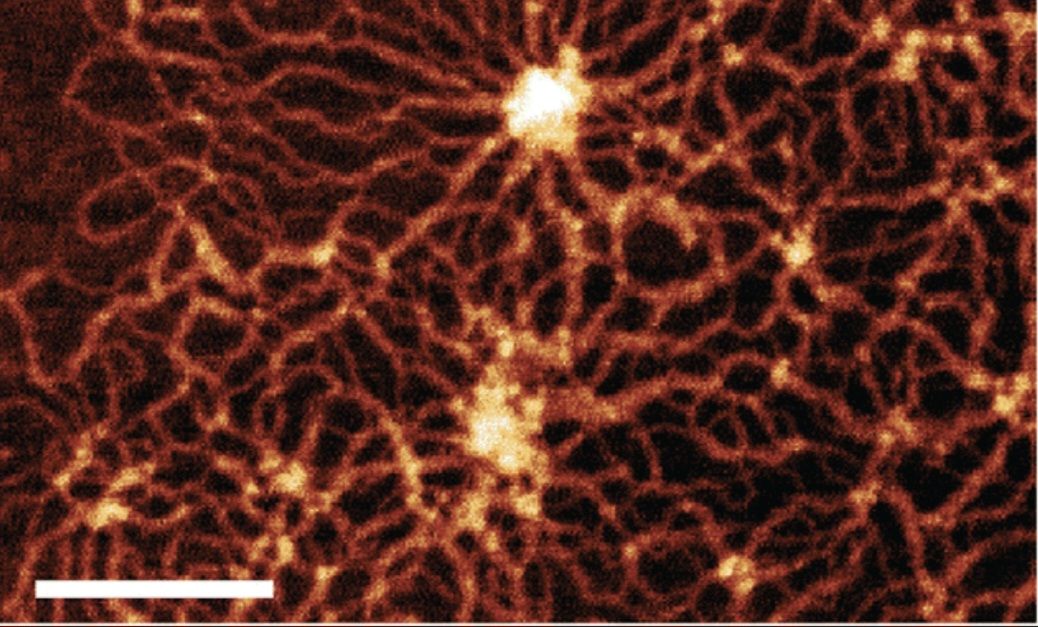
Image: Dr Alice Pyne, University of Sheffield | Published in PCCP paper, November 2024
Dancing DNA
Six feet of DNA is crammed into each cell. The consequent stress makes the molecule twist and writhe in dance-like movements. (Adult humans have about 35 trillion cells – that’s 40 billion miles of DNA per person.)
Video: Scientists at the Universities of Leeds, Sheffield and York combined high-resolution images with simulation | Published in Nature Communications paper by Alice Pyne and others, February 2021
(There’s a non-embeddable but less cluttered version of the Dancing DNA video here.)
In which Baby Jesus, Santa Claus and a pagan shaman debate the true meaning of Christmas.
Image by Alsopinion
Once upon a time, dear Reader – last year, actually – in the nearby dimension where mythical beings live, the house called Christmas had an unexpected visitor.
In the house called Christmas, Baby Jesus lived in the attic with his mother. Santa Claus lived in the main part with Mrs Claus and some elves. A pagan shaman lived in the cellar.
(The absentee landlord, God, lived in a mansion on a nearby mountain. Mother Nature lived next door.)
Many of the beings in that dimension had chosen human form – for the craic. That included the residents of the house called Christmas.
It was a big house, with grounds, paddocks, stables, and outhouses. The residents had their own appartments but there was a shared ground-floor kitchen-diner.
One day, shortly before Christmas, a human called Helen tripped through a gap in the continuum and found herself outside the house.
It was snowing, and the snow lay deep, crisp and even. A sign on the door said “Christmas”. Helen rang the bell – a sleigh bell.
An elf opened the door. “Come in”, he said. “They’re all in the kitchen.” The elf gestured down the hallway, went into a side room and shut the door behind him.
Helen stared after the elf. She heard shouting coming from down the hall and walked towards the sound. A gruff voice shouted, “Fuck you, you fuckin’ little bastard!” She opened the door.
AI illustration by me/Canva
Baby Jesus, with his halo, and Santa Claus, with his red suit, were sitting at a large kitchen island. Baby Jesus was in a high chair. They each had a glass of red wine. There were two empty wine bottles in front of them. A speaker was playing Jingle Bells on the Multiversal Matrix station.
Baby Jesus looked like a baby, but he thought, spoke and drank like an adult. He was drunk, as was Santa.
“Fuck you, yer fucking fat twat!” Jesus slurred angrily at Santa. “You don’ even know where yer from. Is it Greece? Or fuckin’ whatsit, Anatolia? Or the fuckin’ North fuckin’ Pole?!”
Helen, standing in the doorway, cleared her throat. They both looked at her. “Hello,” she said. “Sorry to barge in. I was lost, so I rang the bell. An elf let me in. I’m Helen.”
“Hi,” said Jesus. “Hullo,” said Santa.
Helen looked around. Mary, Baby Jesus’s teenage mother, was slumped in an armchair with a cigarette and a glass of wine.
AI illustration by me/Microsoft Generator
“‘Twat’ isn’t a nice word, darling,” Mary said to Jesus. She waved at Helen.
A Central-Asian-looking man, the shaman, sat at one end of the island, chopping mushrooms. He said, “What about ‘fucking’? Is that a nice word?” Jesus grunted. The shaman winked at Helen.
Mrs Claus sat at a large dining table, rolling a joint.
As supernatural beings, they didn’t need food or drink – or intoxicants. But in their human form, they’d got into the habit. The elves supplied their groceries and dope.
“Hello, dear. Don’t mind them,” said Mrs Claus to Helen. “They’re always like this at Christmas. Come in, have a seat. We get the odd human visitor every now and then.”
AI illustration by me/Craiyon – sorry about the hands
Helen stared at Baby Jesus. He hiccuped. “So,” said Helen to Mrs Claus, “you’re not … human?”
“No dear,” said Mrs Claus. “You’ve strayed into a different world. We’re mythical beings. But don’t you worry,” she added, “Our visitors usually get back – somehow or other.”
“The elves do it,” said the shaman to Helen. “Get you back.”
Helen sat down next to Mrs Claus. “Have a glass of wine, dear,” said Mrs Claus to Helen. She poured one. Helen took a gulp. “Thanks,” she said.
“I’m sorry,” said Helen to Jesus. “I interrupted you. Do please continue.”
“Yeah, well,” said Jesus. He drank some wine. “Thing is,” he added, “Christmas is mine!”
He pointed at Santa and shouted, “He fuckin’ stole it!“.
“Actually, it’s mine,” said the shaman to Jesus. “Your church stole it. Yule.”
“Well, yer’ve still got yer fuckin’ yule log,” sneered Jesus. “Anyway,” he muttered, “I never wanted the fuckin’ church in the first place.”
“But the point,” he went on, “the fucking point is, it’s s’posed to be about my fuckin’ birthday!”
“The clue’s in the fuckin’ name!” he shouted.
“Ah, but,” said Santa. “They don’t say ‘Christ-mas’, with the ‘t’, do they. They say ‘Chris-mas’. Tha’s me – Chris. Chris Kringle.”
Jesus snorted. “Bollocks!” he said. “Tha’s from the German, whatsit, Christkindl. Means Christ child. Me!”
“Yeah, well, it’s me they go on about,” Santa said to Jesus. “Me. It’s Santa this an’ Santa that, innit. Not you. An’ cert’nly not you, Mr fuckin’ Yule.”
“I have my followers,” said the shaman.
“Yeah, a few new-age, sandal-wearin’, tofu-eatin’ hippies. Bless ’em.” said Santa. “Hardly mainstream like me, is it.”
“Mind you,” Santa said to Jesus, “they like your carols, I’ll give you that.”
“They used to be mine too,” said the shaman, sadly. “Kind of. The Holly and the Ivy still is.”
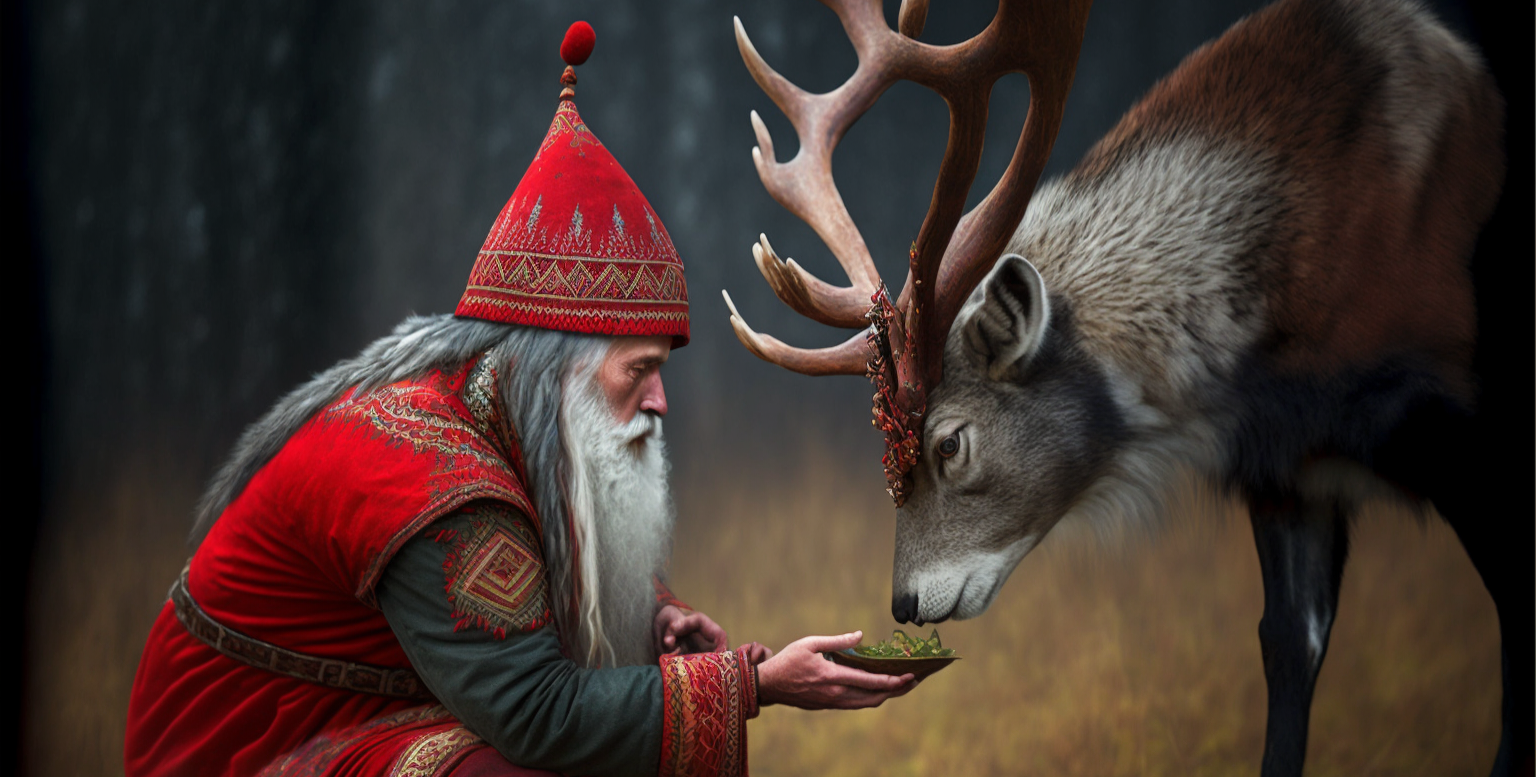
And,” said the shaman to Santa, “you got your red and white and the flying reindeer from me.”
“Matrix,” said the shaman. “Show it.” An image of a Siberian shaman feeding a reindeer appeared on a large wall screen.
Image: unknown
“We flew, tripping on magic mushrooms,” said the shaman.
“Wharever,” said Santa. “Christmas is mine now. So you can both fuck off.”
“You – yer’ve got too big fer yer… stupid fuckin’ boots!” shouted Jesus at Santa. He slumped back in his high chair. He sighed.
“I know,” said Jesus. “I know it’s yours. An’ I’m not gettin’ it back. But I’m better than you. People know that.”
Santa busied himself opening another bottle. The speaker played All I want For Christmas Is You by Mariah Carey. “I like this one,” said Mary.
Mrs Claus lit her joint, took a big hit and passed it to Helen. “Go on, dear,” she said. “It’ll take the edge off.”
Helen took a hit, coughed and passed the spliff back to Mrs Claus. She cleared her throat. “So, Jesus,” she said. He glared at her. “I mean, if you don’t mind me asking. Are you really the Baby Jesus?”
“Hah!” said Jesus to Santa, pointing at him. “She’s not asking you if you’re really Santa, is she?” Santa shrugged.
“‘S complicated,” Jesus said to Helen, “the mythical thing. But basically, yes. I’m a, er, a manifestation. Of the Son of God.”
“So what about Joseph?” asked Helen.
“Not here,” said Jesus. “Not mythical enough.”
“Like me,” said Mrs Claus. “I shouldn’t be here, really. But he can’t manage on his own.”
“Hah!” said Santa. “Probably true.”
“The elves got her in.” said the shaman. “Obviously, I’m not personally mythical,” he added. “More representative. And I help with the reindeer.”
“So you see,” Jesus said. “Helen,” he added. He cleared his throat. “As the Baby Jesus,” he said, with the careful enunciation of the drunk, “I’m here in this house – we’re all here – because of bloody Christmas!”
“What about Easter?” asked Helen. The shaman snorted. “Another one stolen,” he said.
“Ostara,” he said to Helen. “Or Ēostre.”
“Moan, moan, moan,” said Jesus to the shaman. “Yer still got yer soddin’ eggs. An’ yer stupid bloody rabbit.” The shaman sniffed.
“Easter. ‘S a different house,” said Jesus to Helen. Mary sighed.
The room fell silent, apart from the speaker playing Merry Christmas Everyone by Shakin’ Stevens. An elf came in and finished preparing their meal.
AI illustration by me/Adobe Firefly
Helen accepted Mrs Claus’s invitation to join them for dinner. Baby Jesus picked at his food. He’d become maudlin. Helen wished she hadn’t mentioned Easter. The conversation was mainly small talk about yule logs, reindeer and Helen’s family.
Helen wanted to ask Mary about the virgin birth, but didn’t like to. The speaker played Last Christmas by Wham! “Ooh, I like this one,” said Mrs Claus. “Me too,” said Helen. They giggled.
“Still,” said the shaman to Jesus, “Cheer up. You rose from the dead, didn’t you?”
AI illustration by me/Microsoft Generator
“Tha’s right,” said Santa to Jesus. “‘S why my, er, ancestor was doin’ all those miracles. In Anatolia. In your name.”
“S’pose so,” said Jesus.
“Cheer up, dear,” said Mary to Jesus. “It’s Christmas.” Jesus sniffed.
“Always look on the bright side of life,” sang the shaman.
Jesus laughed. “Hah! Very funny,” he said. The elf gave them each a glass of arak. “Anyway,” said Jesus. “Cheers.”
The mood and the conversation lightened. The elf served coffee and then tapped Helen on the shoulder. “You can go back now if you like,” he said. “OK, thanks,” said Helen.
“Follow me,” said the elf. Helen stood up. The others looked at her. “Well, thanks,” she said. “For the lovely meal. And everything. It was really nice to meet you all.”
“You too, darling,” said Mrs Claus. “All the best.”
Helen started to follow the elf, and then she turned back. “Can I just say,” she said. They looked at her again.
“We … humans, most of us, we’re not very religious these days, are we,” she said. “But Christmas is what it is because of all of you.” The others nodded thoughtfully. “So,” said Helen, “Happy Christmas.”
“Yeah, Happy Christmas,” they said, raggedly but agreeably.
‘Time for your nap, dear,’ said Mary to Baby Jesus. He nodded. ‘You too,’ said Mrs Claus to Santa. He grunted.
Helen followed the elf out of the door. The speaker was playing Fairytale of New York by the Pogues and Kirsty MacColl.
Clip from video for Fairy Tale of New York | Image: YouTube
Helen got back safely – the elves had a portal in the living room – and, dear Reader, they all lived happily thereafter.
Helen didn’t tell anyone about her visit to the house called Christmas. She thought they wouldn’t believe her. She died aged 95 in a post-apocalypse commune. (That’s another story.)
The mythical beings had to move further away when their dimension was demolished by the Xogon empire to make way for a new interdimensional highway. (Fortunately, our nearby dimension was just off the route.)
The house called Christmas re-manifested. Baby Jesus, Santa Claus and the shaman continued to debate the real meaning of Christmas. They still got the occasional human visitor. Most of them got back safely.
Christmas continued to the end of time, which was sooner than everyone expected.
your mind disintegrates
you’ve lost control
of your bodily functions
you cling to the wreckage of your mind
you’re living with dementia
advanced dementia
your ego’s shattered
let it go
you’re accidentally Zen
a thread survives, the thread
your core being
you breathe, it answers
follow the guide
follow your breath
let go of the wreckage for a while
float a while
in the ocean of bliss
and forget the forgetting
Hugo Brucciani | 2021
Editor’s note: In a rare interview, Brucciani said he got the idea for this poem from his haphazard hippie studies of Eastern mysticism. “If we’re not our minds or our memories, it should be OK to lose them.”
In any case, it hasn’t worked. We’ve failed to connect with universal consciousness.
About to destroy our environment and probably our current civilisation, no doubt we’re a big disappointment to the conscious universe. If there is one.













 soothfairy