The dark side of the Enlightenment

Decolonise this

I’ve always greatly respected the Enlightenment, the European intellectual movement of the 17th and 18th centuries led by philosophers such as Descartes, Locke, Newton, Kant, Goethe, Voltaire, Rousseau, and Adam Smith.

(I’ve read about them…)

The Enlightenment emphasised reason. I’d looked up to it as a way out of superstition, ignorance and oppression, and as the foundation of modern liberal democracy.

However, the Black Lives Matter movement has exposed the part played by Enlightenment philosophers in justifying the slave trade and slavery by coming up with the idea of white supremacy.

I didn’t know, for instance, that Immanuel Kant said, ‘humanity is at its greatest perfection in the race of the whites’. To be fair, he apparently later recanted (re-Kanted?), kind of, but the damage was done.

Kant, the hypocritical preacher of moral egalitarianism, expounded at length about the failings of the various ‘races’ as compared with the perfect whites. He said black people were stupid. He babbled authoritatively about the qualities of different African ‘races’ in terms of their suitability as slaves.

Such ‘philosophy’ was extremely useful to slave traders and ‘owners’ – not in practical terms, but in terms of moral support for their inhuman enterprise.

Now we know about the Enlightenment’s dark side, and in the woke wake of that awareness students have – understandably – called for decolonisation of the university syllabus. (The Daily Mail‘s response: ‘They Kant be serious!’)

In defence of the Enlightenment, it’s said that Kant & co. were conservative, and we should look to lesser-known radical philosophers of the Enlightenment – Baruch Spinoza, for instance – for its heart and soul.

Maybe so, but those mainstream conservative Enlightenment philosophers built our foundations – which now feel shaky.

Luckily – switch of metaphor! – the fruit of the Enlightenment, liberal democracy (currently the worst form of government apart from all the others) seems not fundamentally poisoned by this racist root. So I’ll still praise the Enlightenment – but less wholeheartedly.

The poison wasn’t Enlightenment philosophy – it was colonialism. It’d be nice to think those two heavyweight phenomena – Enlightenment and colonialism – were fundamentally separate and coincidental, rather than horribly symbiotic.

We need to decolonise our democracy but it’s easier said than done. Having ripped off and destroyed colonial countries, the UK blithely invited large numbers of residents of those countries to move and live here to help rebuild postwar Britain – then blighted their lives with postcolonial racism.

As I argue elsewhere, colonial racism is apparently a twisted version of a redundant anti-stranger instinct (evolved to protect against communicable disease).

If we acknowledge that, we can choose to live above it (as with other ‘monsters from the id‘), so enabling us to oppose and end racism and to decolonise our minds – and our institutions.


This post is an edited excerpt from my longform post Racism explained as a redundant instinct

Top 🔼

As any fule kno…

We think we’re nice, interesting people. But we might not be. But how would we know? Who would convincingly tell us? No one – not even our significant other, if we’re lucky enough to have one – really knows us well enough or cares about us enough to do that. The Sage said, Know yourself. I used to think it’s better to be known. But maybe the Sage had a point. The problem is, if you suspect what a piece of shit you really are, where do you go with that? To a schmychotherapist? Or is it possible just to stop behaving like you’re really great person? To be modest about yourself? Tone down your mask of amusing charisma? Assume the cloak of humility? Worth a try.

Tell the truth then, Soothfairy

…and shame the devil.

That’s the brave challenge I imagine you issuing, dear Reader, given the pretentious name of this blog. But do you really want me to take on the devil? Have you read some CS Lewis or something?

Is telling the truth necessary for good writing, writing that people like reading? No, obviously not. Mainly because we’re not capable of it.

The truth would only be found in the Akashic Record. Revealed by Mme Blavatsky in the 19th century, and touted by hippies in the last one, Akasha’s a record of everything. Every incident with all its background and circumstances. What was done, said, felt, and thought. All of it, for all time, unchangeable. Expensive to record, archive and maintain? No problem – on Planet Akaksha, there’s an energy tree powered by time-looped anti-entropy perpetual motion. Or whatever. Free energy, anyway – in another dimension, basically: Dimension Akasha.

Here on Planet Earth there’s truth with a small ‘t’. (Actually, the word ‘truth’ only ever has a small ‘t’, except for believers.) For humans, truth is slippery, and – embarassingly for the Crown of Creation – impossible to grasp.

We may not be capable of truth. We might know that, and be up for some postmodern fun. But we know what truth – however amusingly diffracted into multiple realities – sounds like. Ring it!

Say I wanted to write about a difficulty I’m having with a member of my, er, extended family. My wife’s family, really. Her sister.

So I had a legal confrontation with her about their dear departed mother’s will. Their mother was blameless, the will was clear – the house was to be divided between four sisters.

This one was the executor. But she thought she was the executive. She didn’t discuss selling the house in order to share it. She lived in the house. Made no attempt to sort things out.

On behalf of the other three, I teed up the law. Her sisters would take her to court if she didn’t cough up. So she did.

Maybe she thought she was protecting them. Given what two of them did with their money, maybe she was right. She’s rated as a good cook, so she can’t be all bad. And she’s disabled. With polio. She also has a small portfolio of rented properties. You couldn’t make it up.

I made her do the right thing. Which she resents, of course. I put a stop to her arrogant mismanagement of her mother’s will. Unforgiveable.

She and my wife are currently friendly, and she and I tolerate each other. But I think she’s secretly seething and avenging herself by demanding more and more of my wife’s time, especially in the evenings, especially Friday and Saturday evenings.

Going out or not, Saturday evening’s special. Even sitting on the couch watching TV. She’s stealing that from me.

My wife knows I don’t like it. She says her sister’s on her own, and there’s nothing special about Saturday, now all the days are the same in covid lockdown.

My wife doesn’t understand me. Ain’t that the half-truth?

Did you like reading that, dear Reader? If so, I told you the the truth – the writer’s truth. If not (or, worse, it was OK, but – blah blah blah), it’s the Limbo step for me.

Top 🔼

Here we are again

Ancestor Australopithecus sediba | Photo: Brett Eloff / Profberger and Wits University

Here we are – animals with consciousness. We’ve achieved civilisation, again. And it’s about to be destroyed, again. Racism, mass poverty, turning on each other, breaking alliances with neighbour states, about to destroy our environment. Vulnerable animals with a big brain. The only protection is world government. Like United Earth in Star Trek.

Known unknown

If universal consciousness caused DNA, it’s ironic that we highly conscious humans, the crown of evolution, are apparently unable to apprehend it – universal consciousness, that is.

Metaphorically, God made man in his own image: with consciousness; but even to conscious humans, God-consciousness (whatever gnostics, mystics and gurus say) is unknowable. Non-metaphorically, science for all its brilliance, is unable to agree on a theory of everything. Metaphorically again, science in its current state can’t look upon the face of God.

I should add that I’m an agnostic. I’m implying design, but not a designer. Evolution is designerless design. I’m suggesting a universal non-divine design process analogous to evolution.

The purpose of universal consciousness in fostering life might be to produce mirror or companion consciousness (perhaps the result of cosmic vanity or loneliness). Or – more darkly – it might be energy farming.

The meaning of meaning

Begun 2017 | 800 words

image

Probability maths says given infinity, a random character generator (producing upper and lower case letters, numbers, spaces and punctuation marks) will reproduce the Complete Works of Shakespeare. Think monkeys and typewriters, if you like.

Shakespeare is wheeled on for this thought experiment rather than, say, Charles Dickens because Shakespeare is the supposed apogee of literary creativity. The reductionist probabilitarians are saying: you think Shakespeare’s great – well, he can be reproduced by empty randomness.

You can kind of see what they mean, and there’s probably not much point arguing with a probability mathematician (though there are valid questions about the abstract concept of infinity) – but it just seems wrong, doesn’t it? The first sentence or two, maybe – but the whole thing? Maybe some things will never happen by chance, even in ‘infinity’.

Then there’s the origin of DNA. Scientists say it can be explained by random chemical events occurring over a very long time. There are several different theories as to how this might have happened, but none of them sounds remotely plausible. As with the randomly reproduced Shakespeare, it just seems impossible.

I know it sounds like I’m on the slippery slope from intelligent design to creationism, but I’m not. I’m suggesting the crucial element in both cases is meaning.

Henry VI, Part One
Scene I: Westminster Abbey. Dead March. Enter the funeral of King Henry V, attended on by Dukes of Bedford, Regent of France, Protector; and Exeter, Earl of Warwick, the Bishop of Winchester, heralds, etc.
Bedford: Hung be the heavens with black, yield day to night!

I’m yawning already, but that’s not the point. The works of Shakespeare, including that opening of the first play, exist because they have meaning. That meaning comes from human consciousness and its medium, language. The unique sequence of six million characters comprising that product of meaning could never be reproduced by chance, I’d suggest.

Wikipedia says DNA is a molecule that carries the genetic instructions used in the growth, development, functioning and reproduction of all known living organisms.

Most DNA molecules consist of two strands coiled around each other to form a double helix. Both strands store the same biological information, which is replicated when the two strands separate. DNA molecules called chromosomes contain an organism’s genetic information.

Does that sound like something that came about by chemicals randomly bumping into each other?

Even if the random bumping went on for a very, very long time (analogous to infinity in the Shakespeare thought experiment), how – without the benefit of natural selection – could it have produced that massively complex self-reproducing molecule? It couldn’t.

Some say RNA, a similar but single-strand molecule currently synthesised from DNA, appeared first, and DNA evolved from RNA. RNA is thought to be capable of self-replication. However, the appearance of RNA in a hypothesised pre-DNA ‘RNA world‘ presents the same problem.

So how could DNA – or RNA – have come into existence? Perhaps it happened because – humour me – the universe (or multiverse, if you like) has meaning, perhaps deriving from universal consciousness. Again, I’d suggest meaning is never the product of random processes.

Random mutation, of course, fueled the natural selection which led from the first living organisms to humans capable of pondering the meaning of meaning. However, randomness and meaning are worlds apart.

Perhaps they’re in a hierarchy, with randomness subject to probability, and probability subject to meaning.

Try as it may, maths and science can’t yet explain the origin of life, what consciousness is, or the ultimate nature of the universe.

I’m a big fan of maths and science. I’d love them to have an explanation for everything; but perhaps some things are unknowable. Perhaps maths, for all its fundamental beauty, is the scaffolding rather than the be-all and end-all.

Perhaps the edifice supported by that scaffolding is a multiverse made of consciousness and meaning.

If so, the meaning of life and the ‘purpose’ of DNA is to reflect multiversal meaning – a reflection exemplified by the works of Shakespeare.

See also my more recent post, DNA – made by ‘God’. Probably.


Pseudo-academic footnote

I thought my post title was original – but, of course, it’s not. The Meaning of Meaning: A Study of the Influence of Language upon Thought and of the Science of Symbolism by Charles Ogden and Ivor Richards has been in print continuously since 1923.

The most recent publication is the critical edition prepared by Terrence Gordon as volume 3 of the 5-volume set C. K. Ogden & Linguistics (Routledge, 1995).

Wikipedia says the book proposes a contextual theory of signs: words and things are connected by signs that are the source of our power over the external world.

(I’d say: sod the signs, it’s language that has the power – the power of meaning.)

The book has apparently been used as a textbook in many fields, including linguistics, philosophy, language, cognitive science, semantics and semiotics.

Umberto Eco described it as ‘a seminal book, whose merit was to say certain things well in advance of its time’.

Damn!


Top 🔺

God is a mixed metaphor

image
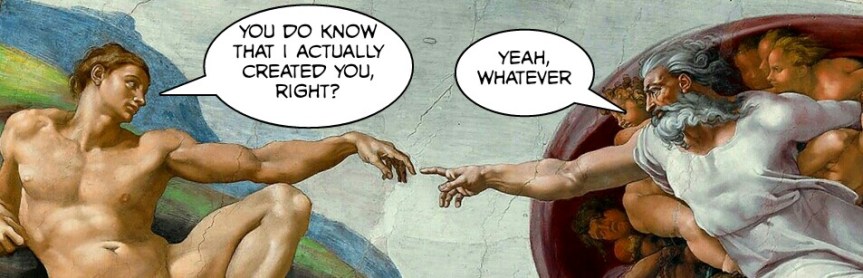
Creationism Painting: Michelangelo

God is a mixed metaphor
Do you know what He is for?
Religion is a form of art
Totality made up from parts of
Goodness, wisdom, power, love
Authority from up above
He’s been dead two hundred years
Poisoned by our hopes and fears

Life is a revolving door
Do you know what it is for?
Philosophy? Ah nah nah nah
Just put you hand upon your car
And swear you will be true to those
Who lie in wait, half comatose
We’ve been stoned two hundred years
We know all your hopes and fears


Top 🔺

Somehow, consciousness

Bad trip or what? | Photo: Ken Russell/Altered States

A 2016 UK Guardian article about films that show how the mind works included an analysis of Ken Russell’s Altered States by radical psychologist Sue Blackmore. She said there isn’t really a ‘hard problem of consciousness’*. She said that ‘somehow’, we should see the mind and brain as the same thing.

If we’re allowed to think that something might ‘somehow’ be true, we might also consider the possibility suggested by radical biologist Rupert Sheldrake: that the brain is a receiver for consciousness, which – somehow – exists outside it.

(Sheldrake is written off as “woo” by some, but for those who bother to read him he makes a good case.)

* The hard problem of consciousness
The name given in neuroscience/consciousness studies to the unsolved problem of how and why sensations acquire characteristics, such as colours and tastes. (See, for instance, this Guardian article on the subject.)

Postscript
I emailed Sue Blackmore. Her reply showed she’s dedicated to opposing the duality that sees consciousness as something separate. Sadly, she doesn’t think much of Sheldrake’s ideas.


Top 🔺

Please feel free to comment.

AI fake news: Turing test (not) passed

Guardian letter 1 (June 2014)

(A Guardian report gullibly repeated a ridiculous claim that the famous test had been passed.)

image
Alan Turing

The Turing test has not been ‘officially’ passed at all. Turing said that most of the interrogators had to be fooled, and that the conversation would have to take a long time. Plus, it’s a chatbot, not an artificial intelligence program; and pretending to be a child whose first language is not English is clearly a cheat.

AI is impossible for the foreseeable future. Intelligence, evolved over millions of years, is a highly complex phenomenon that is not understood and therefore cannot be reproduced by computer code. 

Take humour, for instance. Take one aspect of humour: irony. We take it for granted, but the subtleties of its production and perception are a million miles from ‘AI’ capability.

The AI project has produced some wonderful and life-saving developments in analysis and robotics, but it’s misnamed – and the discussion about intelligent robots is ridiculous.

To begin to create AI, developers (and their funders) should drop the impossible and wildly hubristic current top-level project.

They should slow it down and try to reproduce the evolution of intelligence by analysing its basic but highly complex components: vision and the other senses – and their coordinated interpretation.

Turing was right to make language the test for AI. It’s an end-product of the evolution of social animals. Its structure can easily be ‘analysed’, but it can’t easily be reproduced. The chatbot simulations are just pathetic.

Update 2024
Chatbot simulations are no longer pathetic – there’s been a great leap forward. The likes of GPT-4 can now produce articulate, well-researched answers to questions. But despite continuing false claims, such ‘deep learning’ chatbots still haven’t passed the Turing Test. The problem is conversation. The human in the test has to be convinced over a ‘long time’ they’re talking to another human. Human conversation, a highly-complex feature of our advanced evolved consciousness, is unlikely to be reproduced by machine learning. AI developers are calling for the Turing Test to be scrapped or altered. Pathetic.


Top 🔺 

Please feel free to comment.