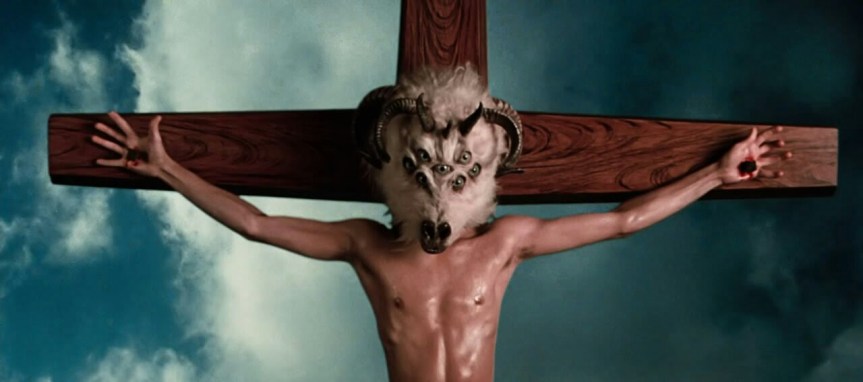
Bad trip or what? | Photo: Ken Russell/Altered States
A 2016 UK Guardian article about films that show how the mind works included an analysis of Ken Russell’s Altered States by radical psychologist Sue Blackmore. She said there isn’t really a ‘hard problem of consciousness’*. She said that ‘somehow’, we should see the mind and brain as the same thing.
If we’re allowed to think that something might ‘somehow’ be true, we might also consider the possibility suggested by radical biologist Rupert Sheldrake: that the brain is a receiver for consciousness, which – somehow – exists outside it.
(Sheldrake is written off as “woo” by some, but for those who bother to read him he makes a good case.)
* The hard problem of consciousness The name given in neuroscience / consciousness studies to the unsolved problem of how and why sensations acquire characteristics, such as colours and tastes. (See, for instance, this Guardian article on the subject.)
Postscript I emailed Sue Blackmore and she kindly replied. Her reply showed she’s dedicated to opposing the duality that sees consciousness as something separate. Sadly, she doesn’t think much of Sheldrake’s ideas. (Perhaps some radicals, ploughing their lone furrows and perhaps secretly yearning for the mainstream, don’t like to be associated with other radicals. Perhaps.)
Cosmic architect Yin was in bad mood. Something had gone wrong. Yin had picked a universe, found a suitable planet, added a moon, seeded life, guided evolution by wiping out the dinosaurs (with, Yin smugly recalled, a well-aimed asteroid), and now, after four billion planet years (no time at all, really) the sodding superconscious beings were about to destroy their environment!
Reason had replaced religion, so further intervention was out – free will was essential. It was tempting to smite that ‘drill, Baby, drill’ fool, but it was a free and fair election, so… The short life span didn’t help. Yin felt bad about that, but it was what happened with evolution. Apparently.
The angels would try to help, but it wasn’t looking good. Another singularity project down the drain, thought Yin. The same thing, or similar, was happening in innumerable universes. Oh well, fuck it, thought Yin. Plenty more fish in the sea.
It’s suggested life somehow developed by means of a series of random chemical interactions – but that’s implausible. Super-complex DNA must have been designed.
During a recent UK BBC Radio 4 discussion, a top scientist working on the origin of DNA (deoxyribonucleic acid), the source of all life, suggested it ‘somehow’ resulted from random chemical interactions of increasing complexity. The scientist’s ‘somehow’ said it all – the suggestion is implausible.
As biochemistry’s understanding of the mind-boggling complexity of DNA has proceeded, so understanding of its origins has receeded.
It’s normal for scientists to fudge this issue. For instance, Prof Brian Cox, the well-known UK physicist and TV science promoter, says:
On our planet we have seen active geology encourage carbon atoms to form into long chain molecules that encode information.
Cox is wrong to imply the formation of DNA is understood. Despite many years of experimental research, all we’ve actually seen is biochemists offering implausible and unproved theories.
Wikipedia’s entry on abiogenesis (the study of how life originated) duly relates the various theories, but says:
…the transition of non-life to life has never been observed experimentally, nor has there been a satisfactory chemical explanation.
Quite so. Without the post-DNA driving force of natural selection, there’s no way random chemical interactions could have gradually increased in complexity to the point of – somehow – ending up as the massively complex, self-replicating, information-coding molecule we call DNA.
Elsewhere in this blog, I’ve suggested DNA is the result of a universal designerless design process analogous to evolution but – like Cox – I was fudging the issue. I was avoiding the difficult but inevitable explanation: the appearance of DNA implies a designer.
The only possible explanation is that DNA was designed and made by a conscious and resourceful entity, which might as well be called ‘God’ – God not as presented by religion but as implied by the sudden and inexplicable appearance of the miracle molecule.
The bonkers idea of Creationism can safely be ignored, but it’s impossible to avoid the idea of Intelligent Design (ID). The covertly religious, evolution-denying ID movement offers mostly slippery pseudoscience. However, DNA’s origin is a special case.
Such special pleading is normally considered a reasoning error, but in this case, as it’s impossible for science to provide a plausible account of the origin of DNA, intelligent design, however improbable, is the only explanation.
ID movement missionaries invoke DNA’s information coding, saying it’s a message from God. That’s nonsense, of course. The code’s not a message – it’s a blueprint for life. DNA’s staggering complexity and purpose is all the proof needed for intelligent design.
Unlike the ID movement’s supernatural God, DNA’s actual intelligent designer must be a natural entity, but one which is currently – perhaps permanently – beyond scientific understanding (as are the probably related – and interrelated – subjects of consciousness and the ultimate nature of matter).
The question inevitably arises: if the life molecule was designed, why? To produce some sort of consciousness singularity event? Humanists can only speculate.
Given that we’ve evolved the amazing ability to control our environment, but seem about to destroy it, it’s a poignant question for us. Are we a failed experiment?
Anyway, I’ll try to enjoy life as far as I can whilst facing the prospect of apocalypse – and the selfish gene’s built-in death sentence – but I’ll respectfully regard life’s mysterious maker with the utmost caution.
Some sayRNA (ribonucleic acid), a similar but single-strand molecule currently synthesised from DNA, appeared first, and DNA evolved from RNA. RNA is thought to be capable of self-replication.
However, the appearance of RNA in a hypothesised pre-DNA RNA world presents the same problem: the unexplained appearance of a massively complex molecule.
The fringe theory of panspermia suggests DNA was brought to Earth from elsewhere either by microbes on trans-galactic debris or – as proposed by Francis Crick, the Nobel prize-winning co-discoverer of DNA’s double-helix structure – by aliens.
In either case, the problem of DNA’s origin remains – albeit in a different place.
If, as seems probable, someone or something made DNA to seed life, what might you call them if you’re not religious?
The AI promptly suggested 12 terms:
There are several non-religious terms that scientists and philosophers have proposed to describe the hypothetical entity or entities that might have created or seeded life on Earth:
Scientific perspectives
1. Panspermia initiators: This term suggests a natural, cosmic origin for life.
2. Primordial engineers: Implies a deliberate, intelligent design.
3. Cosmic architects: Suggests a grand, universe-scale design.
Philosophical and theoretical frameworks
1. The simulator: Inspired by the simulation hypothesis, proposing an advanced civilization.
2. The seeders: Simple, straightforward term for hypothetical life-seeding entities.
3. The originators: Emphasizes their role in initiating life.
Scientifically inspired speculation
1. Advanced extraterrestrial civilization: Assuming intelligent life elsewhere.
2. Quantum fluctuation entity: Considering the role of quantum mechanics.
3. Multiverse inhabitants: Suggests inter-universal travel or influence.
These terms avoid attributing motivations, intentions or supernatural qualities, focusing instead on the hypothetical entity’s role in sparking life.
[Edited by me: essential link added and excessive use of capital letters corrected]
That’s not bad for a souped-up chatbot. ‘The seeders’ has a nice ring to it, but I think I’d go for ‘Cosmic architects’. (‘LIE’ is the only acronym. Is the AI trying to say something? 😉)
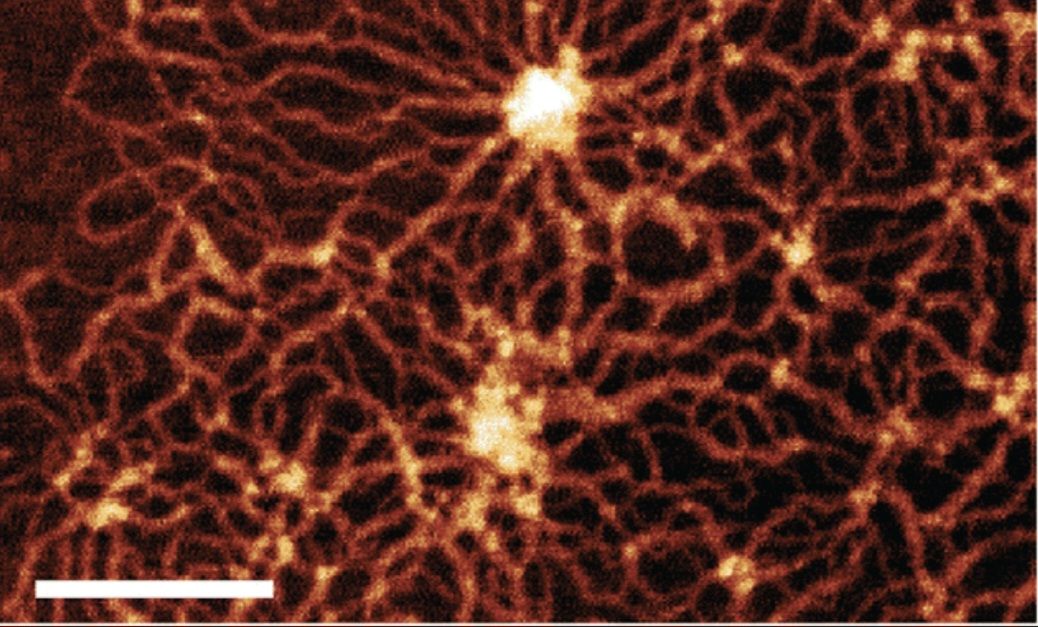
Image: Dr Alice Pyne, University of Sheffield | Published in PCCP paper, November 2024
Dancing DNA
Six feet of DNA is crammed into each cell. The consequent stress makes the molecule twist and writhe in dance-like movements. (Adult humans have about 35 trillion cells – that’s 40 billion miles of DNA per person.)
Video: Scientists at the Universities of Leeds, Sheffield and York combined high-resolution images with simulation | Published in Nature Communications paper by Alice Pyne and others, February 2021
(There’s a non-embeddable but less cluttered version of the Dancing DNA video here.)
In any case, it hasn’t worked. We’ve failed to connect with universal consciousness.
About to destroy our environment and probably our current civilisation, no doubt we’re a big disappointment to the conscious universe. If there is one.
Ancestor Australopithecus sediba | Photo: Brett Eloff / Profberger and Wits University
Here we are – animals with consciousness. We’ve achieved civilisation, again. And it’s about to be destroyed, again. Racism, mass poverty, turning on each other, breaking alliances with neighbour states, about to destroy our environment. Vulnerable animals with a big brain. The only protection is world government. Like United Earth in Star Trek.
Probability maths says given infinity, a random character generator (producing upper and lower case letters, numbers, spaces and punctuation marks) will reproduce the Complete Works of Shakespeare. Think monkeys and typewriters, if you like.
Shakespeare is wheeled on for this thought experiment rather than, say, Charles Dickens because Shakespeare is the supposed apogee of literary creativity. The reductionist probabilitarians are saying: you think Shakespeare’s great – well, he can be reproduced by empty randomness.
You can kind of see what they mean, and there’s probably not much point arguing with a probability mathematician (though there are valid questions about the abstract concept of infinity) – but it just seems wrong, doesn’t it? The first sentence or two, maybe – but the whole thing? Maybe some things will never happen by chance, even in ‘infinity’.
Then there’s the origin of DNA. Scientists say it can be explained by random chemical events occurring over a very long time. There are several different theories as to how this might have happened, but none of them sounds remotely plausible. As with the randomly reproduced Shakespeare, it just seems impossible.
I know it sounds like I’m on the slippery slope from intelligent design to creationism, but I’m not. I’m suggesting the crucial element in both cases is meaning.
Henry VI, Part One Scene I: Westminster Abbey. Dead March. Enter the funeral of King Henry V, attended on by Dukes of Bedford, Regent of France, Protector; and Exeter, Earl of Warwick, the Bishop of Winchester, heralds, etc. Bedford: Hung be the heavens with black, yield day to night!
I’m yawning already, but that’s not the point. The works of Shakespeare, including that opening of the first play, exist because they have meaning. That meaning comes from human consciousness and its medium, language. The unique sequence of six million characters comprising that product of meaning could never be reproduced by chance, I’d suggest.
Wikipedia says DNA is a molecule that carries the genetic instructions used in the growth, development, functioning and reproduction of all known living organisms.
Most DNA molecules consist of two strands coiled around each other to form a double helix. Both strands store the same biological information, which is replicated when the two strands separate. DNA molecules called chromosomes contain an organism’s genetic information.
Does that sound like something that came about by chemicals randomly bumping into each other?
Even if the random bumping went on for a very, very long time (analogous to infinity in the Shakespeare thought experiment), how – without the benefit of natural selection – could it have produced that massively complex self-reproducing molecule? It couldn’t.
Some sayRNA, a similar but single-strand molecule currently synthesised from DNA, appeared first, and DNA evolved from RNA. RNA is thought to be capable of self-replication. However, the appearance of RNA in a hypothesised pre-DNA ‘RNA world‘ presents the same problem.
So how could DNA – or RNA – have come into existence? Perhaps it happened because – humour me – the universe (or multiverse, if you like) has meaning, perhaps deriving from universal consciousness. Again, I’d suggest meaning is never the product of random processes.
Random mutation, of course, fueled the natural selection which led from the first living organisms to humans capable of pondering the meaning of meaning. However, randomness and meaning are worlds apart.
Perhaps they’re in a hierarchy, with randomness subject to probability, and probability subject to meaning.
Try as it may, maths and science can’t yet explain the origin of life, what consciousness is, or the ultimate nature of the universe.
I’m a big fan of maths and science. I’d love them to have an explanation for everything; but perhaps some things are unknowable. Perhaps maths, for all its fundamental beauty, is the scaffolding rather than the be-all and end-all.
Perhaps the edifice supported by that scaffolding is a multiverse made of consciousness and meaning.
If so, the meaning of life and the ‘purpose’ of DNA is to reflect multiversal meaning – a reflection exemplified by the works of Shakespeare.
I thought my post title was original – but, of course, it’s not. The Meaning of Meaning: A Study of the Influence of Language upon Thought and of the Science of Symbolism by Charles Ogden and Ivor Richards has been in print continuously since 1923.
The most recent publication is the critical edition prepared by Terrence Gordon as volume 3 of the 5-volume set C. K. Ogden & Linguistics (Routledge, 1995).
Wikipedia says the book proposes a contextual theory of signs: words and things are connected by signs that are the source of our power over the external world.
(I’d say: sod the signs, it’s language that has the power – the power of meaning.)
The book has apparently been used as a textbook in many fields, including linguistics, philosophy, language, cognitive science, semantics and semiotics.
Umberto Eco described it as ‘a seminal book, whose merit was to say certain things well in advance of its time’.
Bad trip or what? | Photo: Ken Russell/Altered States
A 2016 UK Guardian article about films that show how the mind works included an analysis of Ken Russell’s Altered States by radical psychologist Sue Blackmore. She said there isn’t really a ‘hard problem of consciousness’*. She said that ‘somehow’, we should see the mind and brain as the same thing.
If we’re allowed to think that something might ‘somehow’ be true, we might also consider the possibility suggested by radical biologist Rupert Sheldrake: that the brain is a receiver for consciousness, which – somehow – exists outside it.
(Sheldrake is written off as “woo” by some, but for those who bother to read him he makes a good case.)
* The hard problem of consciousness The name given in neuroscience/consciousness studies to the unsolved problem of how and why sensations acquire characteristics, such as colours and tastes. (See, for instance, this Guardian article on the subject.)
Postscript I emailed Sue Blackmore. Her reply showed she’s dedicated to opposing the duality that sees consciousness as something separate. Sadly, she doesn’t think much of Sheldrake’s ideas.