
Science can’t explain how life began. It must be by intelligent design – but not the religious kind.

December 2024 | Contents
It’s suggested life somehow developed by means of a series of random chemical interactions – but that’s implausible. Super-complex DNA must have been designed.
DNA – made by ‘God’. Probably
Contents
- Introduction
- The fudge
- The only explanation
- Why?
- The ‘RNA world’
- Panspermia
- An AI suggests names
- The wonderful complexity of DNA
DNA – made by ‘God’. Probably
Introduction
During a recent UK BBC Radio 4 discussion, a top scientist working on the origin of DNA (deoxyribonucleic acid), the source of all life, suggested it ‘somehow’ resulted from random chemical interactions of increasing complexity. The scientist’s ‘somehow’ said it all – the suggestion is implausible.
As biochemistry’s understanding of the mind-boggling complexity of DNA has proceeded, so understanding of its origins has receeded.
DNA – made by ‘God’. Probably
The fudge
It’s normal for scientists to fudge this issue. For instance, Prof Brian Cox, the well-known UK physicist and TV science promoter, says:
-
On our planet we have seen active geology encourage carbon atoms to form into long chain molecules that encode information.
Cox is wrong to imply the formation of DNA is understood. Despite many years of experimental research, all we’ve actually seen is biochemists offering implausible and unproved theories.
Wikipedia’s entry on abiogenesis (the study of how life originated) duly relates the various theories, but says:
-
…the transition of non-life to life has never been observed experimentally, nor has there been a satisfactory chemical explanation.
Quite so. Without the post-DNA driving force of natural selection, there’s no way random chemical interactions could have gradually increased in complexity to the point of – somehow – ending up as the massively complex, self-replicating, information-coding molecule we call DNA.
Elsewhere in this blog, I’ve suggested DNA is the result of a universal designerless design process analogous to evolution but – like Cox – I was fudging the issue. I was avoiding the difficult but inevitable explanation: the appearance of DNA implies a designer.
DNA – made by ‘God’. Probably
The only explanation
The only possible explanation is that DNA was designed and made by a conscious and resourceful entity, which might as well be called ‘God’ – God not as presented by religion but as implied by the sudden and inexplicable appearance of the mystery molecule.
The bonkers idea of Creationism can safely be ignored, but it’s impossible to avoid the idea of Intelligent Design (ID). The covertly religious, evolution-denying ID movement offers mostly slippery pseudoscience. However, DNA’s origin is a special case.
Such special pleading is normally considered a reasoning error, but in this case, as it’s impossible for science to provide a plausible account of the origin of DNA, intelligent design, however improbable, is the only explanation.
ID movement missionaries invoke DNA’s information coding, saying it’s a message from God. That’s nonsense, of course. The code’s not a message – it’s a blueprint for life. DNA’s staggering complexity and purpose is all the proof needed for intelligent design.
Unlike the ID movement’s supernatural God, DNA’s actual intelligent designer must be a natural entity, but one which is currently – perhaps permanently – beyond scientific understanding (as are the probably related – and interrelated – subjects of consciousness and the ultimate nature of matter).
DNA – made by ‘God’. Probably
Why?
The question inevitably arises: if the life molecule was designed, why? To produce some sort of consciousness
singularity event? Humanists can only speculate.
Given that we’ve evolved the amazing ability to control our environment, but seem about to destroy it, it’s a poignant question for us. Are we a failed experiment?
Anyway, I’ll try to enjoy life as far as I can whilst facing the prospect of apocalypse – and the selfish gene’s built-in death sentence – but I’ll respectfully regard life’s mysterious maker with the utmost caution.
DNA – made by ‘God’. Probably
The ‘RNA world’
Some say RNA (ribonucleic acid), a similar but single-strand molecule currently synthesised from DNA, appeared first, and DNA evolved from RNA. RNA is thought to be capable of self-replication.
However, the appearance of RNA in a hypothesised pre-DNA RNA world presents the same problem: the unexplained appearance of a massively complex molecule.
DNA – made by ‘God’. Probably
Panspermia
The fringe theory of panspermia suggests DNA was brought to Earth from elsewhere either by microbes on trans-galactic debris or – as proposed by Francis Crick, the Nobel prize-winning co-discoverer of DNA’s double-helix structure – by aliens.
In either case, the problem of DNA’s origin remains – albeit in a different place.
DNA – made by ‘God’. Probably
An AI suggests names
I asked Meta AI:
-
If, as seems probable, someone or something made DNA to seed life, what might you call them if you’re not religious?
The AI promptly suggested 12 terms:
-
There are several non-religious terms that scientists and philosophers have proposed to describe the hypothetical entity or entities that might have created or seeded life on Earth:
Scientific perspectives
1. Panspermia initiators: This term suggests a natural, cosmic origin for life.
2. Primordial engineers: Implies a deliberate, intelligent design.
3. Cosmic architects: Suggests a grand, universe-scale design.
Philosophical and theoretical frameworks
1. The simulator: Inspired by the simulation hypothesis, proposing an advanced civilization.
2. The seeders: Simple, straightforward term for hypothetical life-seeding entities.
3. The originators: Emphasizes their role in initiating life.
Scientifically inspired speculation
1. Advanced extraterrestrial civilization: Assuming intelligent life elsewhere.
2. Quantum fluctuation entity: Considering the role of quantum mechanics.
3. Multiverse inhabitants: Suggests inter-universal travel or influence.
Neutral, descriptive terms
1. Life-initiating entity (LIE)
2. Biogenesis catalyst
3. Genesis agent
These terms avoid attributing motivations, intentions or supernatural qualities, focusing instead on the hypothetical entity’s role in sparking life.
[Edited by me: essential link added and excessive use of capital letters corrected]
That’s not bad for a souped-up chatbot. ‘The seeders’ has a nice ring to it, but I think I’d go for ‘Cosmic architects’. (‘LIE’ is the only acronym. Is the AI trying to say something? 😉)
DNA – made by ‘God’. Probably
The wonderful complexity of DNA
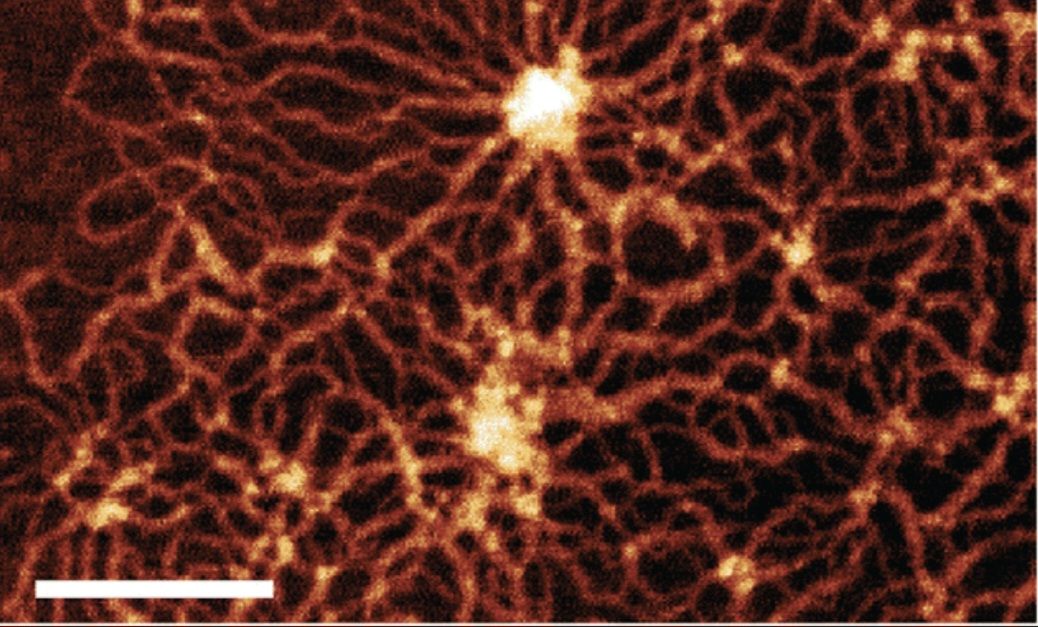
Photo of DNA
This atomic force microscopy image of DNA shows kinetoplast DNA fibril nodes. Scale bar: 150 nanometres. (A human hair is 90,000 nm wide.)
Dancing DNA
Six feet of DNA is crammed into each cell. The consequent stress makes the molecule twist and writhe in dance-like movements. (Adult humans have about 35 trillion cells – that’s 40 billion miles of DNA per person.)
Video: Scientists at the Universities of Leeds, Sheffield and York combined high-resolution images with simulation | Published in Nature Communications paper by Alice Pyne and others, February 2021
(There’s a non-embeddable but less cluttered version of the Dancing DNA video here.)
Then there’s this…
The End


 soothfairy