
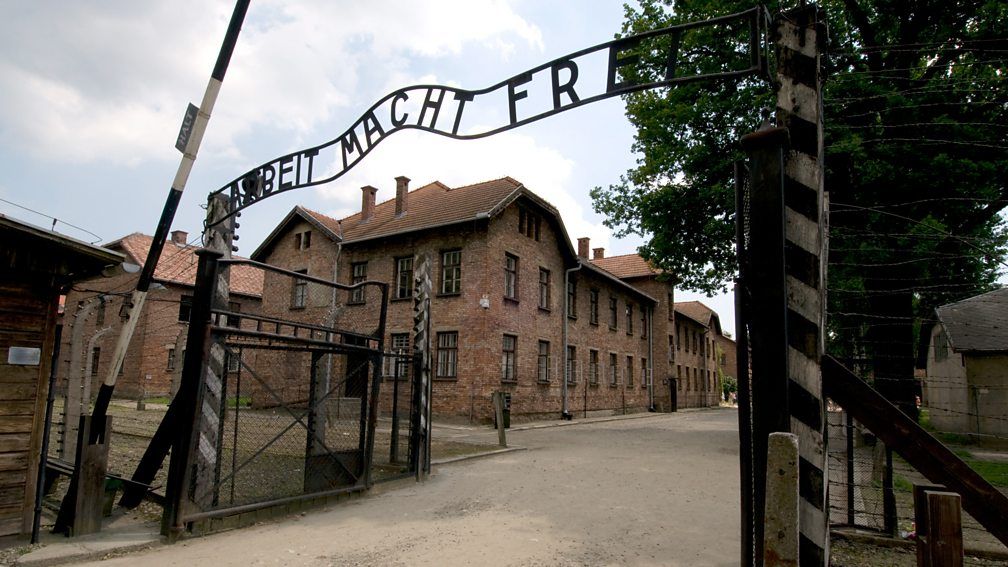
The murder of six million Jews by Nazi Germany, known as the Holocaust, is hard to contemplate. But it resonates – as it should – in our collective memory.
Started August 2016 | last updated May 2025 | 1,700 words | Contents
Note: This post is also a section in my post Racism explained – as a redundant instinct. It uses the words ‘anti-Jewish’ and ‘anti-Judaism’ instead of the inaccurate words ‘antisemitic’ and ‘antisemitism’.
The Holocaust
Top 🔼
Contents
The Holocaust
Introduction
There’s been anti-Jewish racism since the Jews’ most recent exile from Israel by the Roman empire, and their consequent dispersion throughout Europe.
Exile and diaspora is the conventional narrative – but apparently it’s more complicated than that. Apparently, historically, there was no expulsion two thousand years ago.
But however it came about, Jewish diaspora communities lived in Europe. They lived mainly in productive harmony with host communities, but cynical anti-Jewish rabble-rousing led to outbreaks of racist violence, or ‘pogroms‘; and Christian and Muslim extremism led to persecution and expulsion.
The Granada massacre of 1066, a Muslim pogrom in which approximately 4,000 Jews were killed, marked the end of centuries of peaceful coexistence with a liberal Muslim regime in Spain.
The final Christian reconquest of Spain in the late 1400s led to approximately 2,000 Jews being murdered by the Spanish Inquisition and to the eventual expulsion from Spain of over 50,000 Jews.
Savage pogroms continued all over Europe until as recently as the 1940s.
16th-century Christianity reformer Martin Luther publicly recommended the burning of synagogues. Protestant Luther’s beef with Judaism was supposedly theological – but his bitter hatred betrays something less ethereal.

(Ironically, Luther’s modern namesake, Protestant minister and black civil rights leader Martin Luther King, publicly spoke out against black anti-Judaism. He acknowledged Jewish participation in the civil rights movement and he actively – controversially – supported the state of Israel.)
Encouraged by the original Luther’s widely disseminated anti-Jewish rhetoric, 19th-century German ‘race’ theorists and philosophers ramped up the anti-Judaism.
The 19th-century German ‘race’ theorists invented the pseudoscientific word ‘antisemitic’. (See my post about that ridiculous word for a tragic phenomenon, Antisemitism – anti-what??)
German philosopher Friedrich Nietzsche is often accused of anti-Judaism. However, that reputation was created by his sister Elizabeth Förster-Nietzsche, who edited his works after his mental breakdown in 1889 and his death in 1900.
Nietzsche’s sister systematically falsified his writings to match her own virulent anti-Jewish racism. Nietzsche was arguably a protofascist, but he was deeply contemptuous of anti-Judaism and nationalism.
Förster-Nietzsche’s falsifications have since been corrected, but they were current in the 1920s and 30s. The main fakery was in Förster-Nietzsche’s collection of her late brother’s notes, published in 1906 as a book, The Will to Power.
Luther and Förster-Nietzsche were perpetuating derogatory stereotypes of Jews common in Europe for centuries, as exemplified in literature by Shakespeare’s Shylock and Dickens’s Fagin.
For instance, the ‘blood libel’ was a widespread anti-Jewish slur which – ridiculously – accused Jews of murdering Christian children to use their blood in the baking of Passover bread.
Such stereotypes found ultimate expression in the fake but influential 1903 document, The Protocols of The Elders of Zion, which purported to reveal – in great detail – a Jewish plot for world domination.
The Protocols of The Elders of Zion was exposed as totally fraudulent in the early 1920s, but it was taught as factual to schoolchildren in 1930s Nazi Germany. It’s still touted around amongst modern conspiracy theory enthusiasts. (David Icke thinks the ‘Elders of Zion’ are extradimensional beings.)
Anti-Jewish prejudice, unlike most other forms of racism, isn’t colour prejudice. It’s not a reaction to people’s skin colour – it’s white-on-white prejudice.
As with Islam, Judaism is a religion, not a ‘race’. But, although Judaism contains different ethnic strands, the European Jewish diaspora can be said to be a ‘population’, like African or South Asian people. In the social construct sense, they’re a ‘race’. But they’re not a population easily identifiable by appearance. So how does the prejudice arise?
Anti-Jewish prejudice must be a form of culturist racism: specifically – historically – prejudice against the Jewish diaspora, where people of a different culture came to live in or near a settled neighbourhood, not as individuals but as a self-contained community.
Such Jewish diaspora groups arrived at established communities throughout Europe as fringe communities. Romani travellers, also known as Gypsies, who kept moving rather than settling, were similarly outsiders – and were similarly wiped out in the Holocaust.
Jews – like Gypsies – are voluntarily outsiders, not wanting to integrate but keeping to themselves and to their own culture. This marks them out for prejudice – in that being different means being seen as a threat.
The cultural differences are actually harmless – Jews aren’t actually plotting to rule the world – it’s the difference itself that causes fear, probably mainly unconsciously, which manifests as racism.
Culturism, of course, works one way. Racism is power plus prejudice, so the power is with the European majority and the prejudice is against the outsider minority.
(Culturism, as well as underlying white-on-white anti-Judaism, probably also boosts white-on-black colour prejudice, in that a different skin colour indicates a different culture.)
The Holocaust
The Holocaust
European anti-Judaism climaxed in the 1940s in Nazi Germany with the Holocaust, Adolf Hitler’s insane, genocidal ‘final solution to the Jewish question’.
Hitler’s anti-Jewish fascism was boosted by:
- Widespread, centuries-old European anti-Jewish stereotypes and culturist racism
- The anti-Jewish writings of German uber-Protestant Martin Luther
- Racist 19th-century German pseudoscientific ‘race’ theory
- The protofascist ‘übermensch‘ writings of German philosopher Friedrich Nietzsche
- The anti-Jewish falsifications by Nietzsche’s fascist sister, Elizabeth Förster-Nietzsche in his posthumous book, The Will to Power.
- The 1903 document The Protocols of The Elders of Zion, exposed as fake in the 1920s but taught as factual in German schools in the 1930s
- Racist, pseudoscientific US eugenics programmes funded by the Carnegie Institution, the Rockefeller Foundation and John Kellogg.
Nazi Germany’s increasingly brutal 1930s anti-Jewish campaign ended in genocide when Jews were sent to extermination camps. In the death camps, the German state systematically murdered six million Jews.
Between 150,000 and 1.5 million Romani people were also murdered by the state.
The Holocaust
How could they do that?
For those of us who oppose racist anti-Judaism, the Holocaust’s meticulously organised murder of six million Jews haunts our imagination. It’s difficult to understand how people could have done that.
In 1961 the trial of high-ranking Nazi Adolph Eichmann took place in Israel. Eichmann, who’d been instrumental in organising the Holocaust, famously said he’d merely obeyed orders.
Yale professor Stanley Milgram, a Jewish social psychologist, heard about Eichmann’s defence and posed this question:
-
What is there in human nature that allows an individual to act without any restraints whatsoever, so that he can act inhumanely, harshly, severely, and in no ways limited by feelings of compassion or conscience?
My bolding
Milgram then conducted a famous and controversial series of ingenious experiments – with shocking results.
Milgram showed that ordinary people in thrall to white-coated authority figures were willing to inflict what they believed to be severe pain and even death on strangers. (The strangers were played by actors.)
Questions have understandably been raised about the ethics and methodology of Milgram’s experiments. Their relevance to the Holocaust has been questioned. But Milgram’s basic findings still hold true.
The Holocaust authority figures themselves must have had some form of empathy-deficient mental disorder such as psychopathy. But more disturbingly, ordinary people in that situation were able to set aside their empathy.
Perhaps, however, the Holocaust executioners were not only acting in innate obedience to authority figures, as suggested by Milgram’s experiments, but were also indulging an instinctive racist urge.
The Holocaust
After the Holocaust
Ironically, extreme nationalism – a main factor in the Holocaust – is now a charge made against the powerful US-backed state of Israel in its ongoing conflict with Palestinian people, many of whom were expelled from their homes and homeland during the controversial establishment of Israel which began in 1948.
Equally ironically, the number of Palestinian people registered as refugees (in 2025) is six million. (There are about seven million Jewish people living in Israel.)
Following an attack on Israel in October 2023 by Hamas, the militant group running the Palestinian Gaza Strip, Israel launched the one-sided Gaza ‘war’ against Hamas during which many tens of thousands of Palestinian civilians, including children, have been killed or seriously injured by the IDF – the Israeli ‘defence’ forces.

The International Criminal Court (ICC) accused the Israeli premier of war crimes and crimes against humanity, and – in the final irony – Israel was accused of genocide.
Supporters of the Palestinian cause who criticise Israeli Zionism are accused (perhaps correctly in some cases) of anti-Jewish racism. And so it goes.
Also, showing no one’s immune, there’s Jew-on-Jew racism in Israel, in particular against Ethiopian Jews.
A Sephardi (Jews of North African origin) chief rabbi reportedly said there could be no explanation other than ‘pure racism’.
Outside Israel, despite the terrible lesson of the Holocaust, anti-Judaism continues to thrive.
A 2008 report by the US department of state found there was an increase in anti-Judaism across the world, and both old and new expressions of anti-Judaism persisted.
A 2012 report by the US bureau of democracy, human rights and labor noted a continued global increase in anti-Judaism, and found Holocaust denial and opposition to Israeli policy were used to promote or justify anti-Judaism.
The German government has paid over $90bn in compensation to the victims and survivors of the Holocaust and their heirs.
The End


 soothfairy