The slave trade and slavery in the Americas

Started August 2016 | last updated May 2025 | 1,000 words | Contents
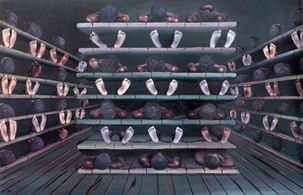
European colonialism fucked up the whole world in many ways. But by far the worst thing was the Atlantic slave trade and slavery in the Americas. That terrible crime remains unresolved. Its aftermath blights the lives of millions of black people living in the US, the UK and elsewhere.

This is a standalone version of a section in my post Racism explained – as a redundant instinct.


The slave trade and slavery in the Americas
Top 🔼

Contents


The slave trade and slavery in the Americas

Contents 🔼

Introduction

The misery of slavery has, of course, existed in nearly every culture, nationality, and religion from ancient times to the present day – with or without any ‘justification’.

Estimates of the number of modern slaves range from 21 to 46 million. Perhaps this shows humans have an innate capacity to see certain ‘categories’ of our fellow humans as ‘other‘.

Slavery is thought to have been rare amongst hunter-gatherer populations. It really took off after the invention of agriculture about 11,000 years ago.

Perhaps hunting and gathering was an interesting and sociable activity, whereas farming was boring and tedious. Perhaps thoughts turned to how to get someone else to do it for you, preferably for free.

Farming led to city states, which led to warfare and captive slaves (and which later led to capitalism and wage slavery). Bingo!

The Bible condones slavery. Its purported moral superiority was wielded by cynical colonialists and deluded missionaries to replace indigenous culture, but the ‘Good Book’ wasn’t so good. It blithely accepted the fundamentally immoral practice of slavery.

In the Old Testament, check the terms and conditions that follow the Ten Commandments. In Exodus 21:26, slavery is clearly accepted as perfectly normal.

The New Testament continues to accept slavery. For instance, in Ephesians 6:5, the letter writer, possibly Paul, urges slaves to obey their masters.

Jesus’s powerful message of meekness triumphant was cynically exploited by colonialist Christian missionaries to encourage African acceptance of the European occupation – and of slavery in the Americas.

What would Jesus – apparently a real person and a radical teacher – think of such wickedness done in his name? (He said, Give to Caesar what belongs to Caesar, but that was coming from an occupied Jew, not from an imperialist Roman.)

The much-romanticised Anglo-Saxon age in Britain (I’m British – Hi) featured slavery, known as chattel slavery. Norman invader William the Conqueror is rightly hated for his legacy of land-grabbing aristocracy – see my post, The super-rich – law and order – but he did at least one good thing: he ended chattel slavery.


The slave trade and slavery in the Americas

Contents 🔼

What white people did

Four hundred years after the end of Saxon chattel slavery, European colonialists reinvented slavery. Bolstered by ideological racism, they latched onto existing African slavery systems and created the massive Atlantic slave trade, thereby instituting a whole new level of organised vicious inhumanity.

An estimated 12 million slaves were forced into the Atlantic trade between the 16th and 19th centuries. About four million died in Africa after capture, 1.5 million died on board ships, and 10.5 million reached the Americas to work on plantations.

The death rate on plantations was high, a result of overwork, poor nutrition and work conditions, brutality and disease. Many plantation owners preferred to import new slaves rather than provide the means and conditions for the survival of their existing slaves.

Kindness and conscience eventually prevailed. Opposition to slavery and to the slave trade began in the 1770s. The abolition of slavery was completed in the Caribbean by 1850; and in the US by 1865.


The slave trade and slavery in the Americas

Contents 🔼

After slavery

The US didn’t compensate the ‘owners’ of enslaved people, but the British did. Disgustingly, the 1833 Slavery Abolition Act required British ‘owners’ to be compensated.

The UK government borrowed £20m, equivalent today to £17bn. (It took until 2015 to complete the loan repayment.) 47,000 ‘owners’ got compensation.

No money and no apology has ever been given by the UK or the US to the enslaved people or their descendants.

As well as compensating ‘owners’, Britain managed to continue the racist brutality. Instead of being freed, enslaved people under British rule were forced to continue their slavery for four more years in the name of ‘apprenticeship‘.

Under the ‘apprenticeship’ regime, the brutal punishment for working too slowly or taking time off included being hung by the hands from a plank and forced to ‘dance’ a treadmill.

America the Beautiful is scarred by its ugly legacy of slavery. Sixty years after the achievements of the civil rights movement, the African American minority continues to face systemic and personal discrimination and prejudice.

The legacy of slavery wasn’t quite so bad in the Caribbean. After abolition, former slaves were in the majority in the islands, and, after independence – achieved between 1962 (Jamaica, Trinidad and Tobago) and 1983 (St Kitts and Nevis) – their descendants went on to assume power.

However, the UK African Caribbean minority – those who migrated to the UK in the 1950s and 60s and their descendants living in the UK – have faced, like the African American minority, prejudice and disadvantage due in part to the legacy of slavery.


The slave trade and slavery in the Americas

Contents 🔼

No compensation

The profits from slavery created vast wealth for white UK and US ‘owners’ of enslaved people. None of the perpetrators of that vile crime were held to account – and none of the proceeds were confiscated.

On the contrary, the UK government compensated the perpetrators and profiteers. 47.000 (47. Thousand) UK ‘owners’ of enslaved people were compensated for their ‘loss’. The government took out a massive loan and gave each ‘owner’, on average, about £400,000 by today’s values.

The African enslaved people were given nothing by the UK or the US – except, in the case of US freed people, the famous broken promise of forty acres and a mule.

The German government has rightly paid over $90bn in compensation to the Holocaust survivors and the victims’ heirs.

But there’s a shameful lack of any equivalent compensation paid to the heirs of the victims of the Atlantic slave trade and slavery in the Americas by the governments that permitted, colluded with, perpetrated and profited from those terrible crimes.

The descendants of enslaved people have been given nothing except the after-effect of slavery: devastating personal and institutional postcolonial racism.

Black descendants of of the victims of slavery understandably resist being seen wholly as victims themselves because it undermines their fight against racism. Nevertheless, they are victims – of post-slavery racism. As such, they’re entitled by natural justice to compensation.

But that same racism, disguised as fiscal caution, means that, sadly, it’s not going to happen.

Contents 🔼

The End

Cosmic architect: Earth crisis – fuck it

Illustraton: AI / Mahardicka

Cosmic architect Yin was in bad mood. Something had gone wrong. Yin had picked a universe, found a suitable planet, added a moon, seeded life, guided evolution by wiping out the dinosaurs (with, Yin smugly recalled, a well-aimed asteroid), and now, after four billion planet years (no time at all, really) the sodding superconscious beings were about to destroy their environment!

Reason had replaced religion, so further intervention was out – free will was essential. It was tempting to smite that ‘drill, Baby, drill’ fool, but it was a free and fair election, so… The short life span didn’t help. Yin felt bad about that, but it was what happened with evolution. Apparently.

The angels would try to help, but it wasn’t looking good. Another singularity project down the drain, thought Yin. The same thing, or similar, was happening in innumerable universes. Oh well, fuck it, thought Yin. Plenty more fish in the sea.

AI can mean leisure – with UHI

November 2023

Look into my eyes…you will subscribe to X Premium | Detail of book cover photo: Art Streiber/August | Book: Elon Musk / Simon & Schuster, 2023

Note: Social credit as referred to here is nothing to do with the Big-Brother Chinese social credit system

At a 2023 UK conference on artificial intelligence, visiting US multi-billionaire Elon Musk – owner of Tesla and X – put forward a good idea: universal high income. But it’s not original.

100 years ago the UK Social Credit movement said (in effect – there was some complex economic and religious theory) that technology could mean leisure if the state paid a ‘dividend’ to all.

The dividend wouldn’t have been a handout. It’s owed to the people for the underpaid contribution made by them and their ancestors to the current wealth. (That debt still hasn’t been paid.)

Back then, it never happened (apart from some half-baked Canadian experiments), and the movement all-but fizzled out.

However, the movement survived – as the UK Social Credit Secretariat. Also, currently trending, there’s a related but highly diluted version: universal basic income (UBI).

At the 2023 AI conference, Musk said artificial intelligence means no one will need to work, but only if they get a universal high income – a universal basic income would be insufficient.

Unusually for Musk, this makes sense: a state-provided universal high income (UHI) could replace wages, thereby allowing civilisation to continue without wage-slavery.

And there’s no need to hang it on the futuristic threat of mass job-losses caused by AI. We can do it right now.

But how can a UHI be funded? At, say, £20,000 a year for all adults, it’ll cost the UK over £1tn a year – which obviously can’t be tax-funded.

A UHI can only be funded by the state issuing money as social credit – meaning money issued as credit for the good of society – rather than banks issuing money as profit-making debt.

States currently – historically – outsource their legal responsibility for issuing money: they delegate it to banks. Almost all money is issued by banks as debt – and is then lent to the state! It’s legalised bank robbery: robbery by the banks.

But states can reclaim their responsibility for issuing money and end the environment-destroying debt economy by issuing all money as social credit.

Such social credit will replace income tax and state borrowing. It can fund a UHI and all social spending: green energy, transport, water, health, care, housing, justice, education, infrastructure, defence, etc.

All debt, personal and business, can be forgiven – it’s a new start.

£2tn a year should do it for the UK. The Bank of England can finally make itself useful and stop kowtowing to neoliberal ‘market forces’.

The £200bn or so a year currently invested in UK businesses can be given interest-free to monitored business accounts on receipt of sound business plans including green, social and inclusive considerations.

The UK stock market will reform to facilitate this. Savings accounts and pension funds can contribute to investment by trading in the reformed stock market and sharing the profits of successful companies.

However, the ‘growth’, consumerism and built-in obsolescence needed to service debt will no longer drive business policy.

Privatised utility shareholders can be paid off and utilities run as non-profits.

The unconditional UHI will replace benefits and the state pension. People will, of course, be free to take whatever work is available or to run businesses – for extra money or for personal fulfillment.

There’ll be no hyperinflation: the social credit money issued wil be spent into the economy in a virtuous cycle.

There there’s the pleasure of telling the international money market, the World Bank and the IMF to go fuck themselves. A nation’s social credit money will be intrinsically acceptable for international trading purposes.

One loss will be bankers’ bonuses. What a shame. (Deprived of their scam, banks will have to find a more useful – if less lucrative – role.)

(See also my post Robots could mean leisure.)

Please feel free to comment. (I answer all comments.)

Universal Basic Income is too basic

The Money Tree | Image: Shutterstock

UBI, Universal Basic Income, is wrong because it’s basic. The ‘B’ should stand for ‘Big’, not ‘Basic’.

UBI is basic because it’d be tax-funded. But a Universal Big Income big enough to replace wages could be funded by social credit.

The pandemic has shown there’s a money tree and it’s not magic. Historically, governments have allowed banks to issue almost all money – as debt. The consequent debt economy, with growth needed to service debt, is inherently destructive of our life-support environment. It also obliges governments to be funded by tax – and by borrowing!

If governments take back their right and responsibility to issue money, they can issue it as social credit. This would fund social spending – healthcare, education and infrastructure – and could also fund a universal big income.

People would then be free to work as much or as little as they want. People might choose to work – for more money, for the pleasure of it, or as a volunteer.

With a generous state income funded by social credit, increasing automation would mean increasing leisure, as it always should have.

Top 🔼

The super-rich, law and order

image

Rule of law? Listen, darling, if you’re old enough to drink, you’re old enough to understand this. The rich got rich by stealing the land from the people. 1066 and all that, you know. Then we had to protect our wealth from the people.

So we implemented a legal system with extremely harsh punishments for theft or insurrection. That’s what the law’s for – to protect us, the rich.

We created a powerful thing, not so easy to control. Of course it protects the poor as well now, doesn’t it. To carry on protecting us in these ‘democratic’ times, the law must be seen to serve everybody. The people know the truth, kind of, but for the sake of a quiet life they go along with it.

Some of us got super-rich. We’re above the law. Sure, there has to be a sacrifice every now and then. One of us gets tossed on the bonfire, for the sake of appearances. But apart from that, we’re functionally above the law.

Down there, the degree of inequity is such that law and order is needed to prevent unrest. Shall I use a metaphor, dear? If the pit props of the law break, the goldmine of civil contentment will collapse. That’s not good for us. The people would be ruled by gangsters, and we’d have to find another way.

The people could run things themselves, of course, and share out the wealth – but how would they overcome the gangster warlords that would take over? That’s why they go along with our law – the alternative’s too scary! They’re basically sheep, Darling – and we’re the big, bad wolves!

You know, dear, people in poor countries – not having the judicial superstructure and public service integrity they’d need for effective law – would love our western law and order. No more extortion by gangsters, or the corrupt secret police knocking on your door in the middle of the night.

So we’re the founders of the law, Darling, but these days, it has to keep us at arm’s length. It serves us all, rich and poor alike. Simply delightful!

Democracy suits us. We don’t have to lift a finger, apart from the occasional meeting or intervention. The system practically runs itself, on bread and circuses. And thanks to the offshore magic, we don’t even have to pay for it! Marvellous!

The state’s a wonderful thing, darling. It does everything for the people, so they don’t have to care. They just pay taxes. It makes them selfish and spiritless. They don’t think about inequity – or about us.

And since our 80s neolib intervention – you know, privatisation, deregulation, and so on – they pay us to run it! It’s perfect!

‘Lobby’ – it’s a strange word, isn’t it. But that’s how we run things. We ‘lobby’ the politicians and they do what we say. Some protesters call it corruption, but repressive tolerance keeps them quiet, bless them.

Watch the drinking, and it’s a wonderful life. I know, we can’t buy immortality yet. That’s why we’re crowd-funding that project, isn’t it.

Climate crisis? Yes, it’s a thing, sweetie. Why are we funding the deniers? It’s a habit, isn’t it. It’s crises that make us richer and more powerful. It goes critical, we could be fucked, true. But if we ride it out – it’s the mother lode!

There was Peter Thiel’s New Zealand thing, of course. You know – PayPal founder, Trump nutter? You can’t buy a democracy off – well, not like that. But it was a useful distraction, wasn’t it.

Trump? yes, he and most of his supporters, like Thiel are nutters: psychopaths and narcissists. But he’s good for us – he’s one of us! Ramping up crisis. privatising security – it’s all good!

As for climate refuge, there’s Putin’s stealth enclave in Fuckistan, wherever. You know? Self-sufficient food, water, energy, security. Luxury, as per. Shangri-fucking-La. Entry, a billion per family, a million a head per year til it blows over.

He’s another psycho, so it’s a bit risky. But basically he’s one of us – the richest of us all, dear. And when it’s over, the world – what’s left of it – is ours. Well, yours, probably. New laws. New order!

Little more Dom, darling?


Top 🔺

Robots could mean leisure

Guardian letters: November 2015, June 2016, July 2016, June 2017July 2017 and June 2109 (Chris Hughes).

Rolling post begun February 2016, last updated June 2019

picsay-1467846340246.jpg
Image: Futurama

According to a 2015 newspaper report, Bank of America Merrill Lynch forecast the increasing use of robotics, and warned that this would exacerbate social inequity. Perhaps they were really more worried about unrest than inequity.

The Social Credit movement addressed this issue 100 years ago, saying that increased automation should mean increased leisure. However, this would need a radical reform of the banking system, so that a national dividend income can be paid to all.

This income, paid regardless of whether and how much people work, would be linked to national productivity and should be enough to live comfortably. The income wouldn’t be a gift. It’s money owed in lieu of the underpayed contribution by many generations to the current general wealth.

image

Original illustration: Elizabeth Webbe from The Little Mailman of Bayberry Lane by Ian Munn

Redistribution by taking the wealth of the super-rich might be a Good Thing, but it isn’t needed to fund this. If governments fulfil their responsibility to control the money supply, they can end the debt economy and pay the income by issuing, yes, social credit (which can also fund infrastructure projects and social services such as health and education).

Top 🔺

Postscript

Amazingly, the world has caught up with me. I thought the idea was languishing in the archives of Social Credit, and that the UK Green Party’s sickly citizens’ income had been strangled at birth by its mean anti-scrounger nannies, but, hallelujah, it’s been reborn (in the 1980s – who knew?) as the currently trending idea UBI (Universal – or Unconditional – Basic Income).

I think there’s a problem with ‘basic‘. The income should be more than basic – it should be comfortable. But it’s good that the, er, basic idea has a new lease of life.

There’s a Social Credit response to UBI. They say the income should be basic – plus a share of the economy’s productivity. (However, my understanding is that the Social Credit national dividend doesn’t actually guarantee a basic income, but is entirely dependent on the performance of the economy.)

For UBI see, for example:
🔸Campaign groups Basic Income UK and BIEN (Basic Income Earth Network). BIEN has a good history of UBI (although its section on Social Credit doesn’t explain that SC’s national dividend is funded by government-issued credit, not by taxation).
🔸An informative Guardian article

Some relevant books:
🔸Inventing the Future, by Nick Srnicek (pronounced ‘Sirnichek’, I think) and Alex Williams
🔸Utopia for Realists, by Rutger Bregman
🔸The Precariat: The New Dangerous Class by Guy Standing
🔸Real Freedom for All: What (if anything) can justify capitalism by Philippe Van Parijs

Some related ideas:
🔸Accelerationism
🔸helicopter money
🔸people’s quantitative easing.

June 2016 – still trending:
An excellent Guardian article by Philip Oltermann reports a poll finding: 68% of people across Europe would vote for UBI. Also, Switzerland is about to vote on a proposed unconditional national basic income of £1,750 a month. That’s more like it. But another poll shows 60% of the Swiss against it. The problem is, UBI advocates don’t seem to understand the funding solution (control the money supply), and witter about funding it by tax, which obviously puts people off.

Missing the point – the watered-down version trudges on

An interesting but flawed report on UBI by economists Howard Reed and Stewart Lansley published by leftish campaign group Compass is to get a high-profile launch by Labour shadow chancellor John McDonnell. The report proposes an income of £70 a week funded by tax increases. Readers will search in vain for ‘money supply’ or ‘social credit’.

I asked the report’s authors about this. Stewart Lansley said they considered including funding options, but decided that anything radical would detract from the their central idea – that UBI would be feasible within existing institutional arrangements. Hmm. There’s a danger that the new UBI baby is being strangled – as was the Greens’ citizens’ income – by Nanny Normal. With something like this, you have to – as the Guardian says (see below) – dream big.

UBI proponents need to understand that their dismal basic income isn’t enough – and that a universal income big enough to replace wages (Universal Big Income?) can only be sustainably funded by the government issuing social credit. To be fair, there are different approaches in the UBI movement. For instance, BIEN co-founder Guy Standing argues for a social dividend funded by income from publicly owned assets. Not as good as social credit – but better than basic income funded by tax.

Straw man burns – quite a week for UBI
🔸The Swiss, as predicted, turned down the generous but unfunded UBI proposal (77% against).
🔸The Grauniad weighed in with an editorial on UBI (it’s OK to dream big, but proceed with caution).
🔸Reporting on McDonnell’s launch of the Compass report, the Guardian said that Labour is considering the idea of a UBI.
🔸The Guardian had a Saturday sum-it-all-up above-the-fold letters section on UBI which included – ahem – one from me (Chris Hughes) about funding UBI.


imageTwo out of five ain’t bad | The Guardian, Saturday 11 June 2016

Of the five printed letters, two were supportive of UBI. LSE economist Ian Gough (against – it’ll drain the energies of the left) said pithily of the Compass proposal, ‘Thus a powerful new tax engine will pull along a tiny cart (a partial and inadequate basic income). Why bother?‘ Quite.

Progressive alliance could implement UBI
The Brexit result of the UK referendum on whether to leave or stay in the EU surprised nearly all commentators and pollsters. (However, see my prophetic post, The east European elephant, about the danger of ignoring the views of poor whites – Guy Standing’s ‘precariat‘, perhaps.) In the post-referendum political turmoil, Labour MPs tried and failed to remove leftwing leader Jeremy Corbyn (elected in 2015 with huge support from Labour members). This brings the new progressive movement into focus. If Labour splits, there could be some interesting reorganisation. But as (anti-Corbyn) Labour veteran and former leader Neil Kinnock said recently, realignnent without proportional representation is fragmentation. There’d need to be (as someone else has probably said) a pre-election progressive pact with one item on the agenda: enact PR, then hold a second general election. It’d be a happy coincidence of party self-interest (sustainable survival) and political principle (improving democracy). That way, the political landscape can open up; new political eco-systems can develop; existing institutional arrangements can be changed; and the government can control the money supply and fund a Universal Big Income. Bingo! (UBIngo!)

Update: January 2017

Labour didn’t split. However, it’s lost so much support, it might need an alliance. But it probably won’t be a progressive one. Oh well.

Meanwhile, Finland has launched a two-year experimental scheme to pay the unemployed an unconditional £475 a month. It’s basic, but it’s not UBI. But it’s the first unconditional state income for the unemployed in Europe. Which is something. Better than nothing.

Since then, nothing much, I’d say…


Top 🔺

Please feel free to comment