Digest: He hated the first screenplay he saw, but loved the second one – and he raved about the pre-release screening he saw!
Dystopia: Blade Runner‘s Los Angeles | Warner Bros
December 2025 – the lost post
Sadly, my original longform post was somehow deleted from my blog in November 2025, presumably by me by mistake. (By the time I realised, the trash had been emptied. And WordPress.com doesn’t do auto-backup – at least not on my budget ‘plan’.)
After I’d finished weeping and wailing, I found an as-viewed version dating from December 2024, fortunately archived by the wonderful Wayback Machine. There’s a link to it below.
Theres no way I can redo this as a proper post, and no way I can remember and redo the many edits and additions I made between December 2024 and November 2025. They’re lost, like tears in rain. (Too much?)
One thing: I’d like to take back everything I say in my post about BR 2049. I just watched it again and realised – it’s really good! Clearly, I didn’t watch it properly the first time – I must have been too stoned. Sorry, Dennis. Sorry, Hampton. Sorry, Ryan.
Another thing: just before I realised the post was lost, I was about to add something about Hampton Fancher’s screenplays and whether Ridley Scott read the book.
I’d come across a fascinating 1981 interview* in which co-writer David Peoples said Scott was very interested in the book’s animal theme but they hadn’t been able to use that. Apparently Scott got that interest not from reading Dick’s book – he started and found it ‘too difficult’ – but from Fancher’s screenplay(s).
*Interview in Starlog #85, May 1982: Blade Runner: Screenwriters Fancher & Peoples Clear The Air by film historian and author James Van Hise.
So maybe Fancher was more sympathic to the book than I’d realised. Maybe my post misrepresents the Dick-Fancher conflict.
In 1981 Dick said of his 1975 association with Fancher: ‘We had a lot of fun together. I became real good friends with him.’ But he dismissed Fancher’s script as a ‘destruction of the novel’ and ‘Philip Marlowe meets The Stepford Wives‘.
Perhaps that’s why Fancher gainsaid Dick’s recollection of fun and friendship, dismissively saying (in 2017) that although Dick was a genius he was ‘crazy’ and ‘took all the oxygen’.
Perhaps Fancher, apparently the only person involved with the film who actually read the book, deeply resented Dick’s criticism.
Dick then saw a later script, which he understood to be a rewrite by Peoples, the experienced writer brought in by Scott. Dick praised the new script as a miraculous transformation of Fancher’s script – a transformation based on Peoples’ supposed reading of the book. Dick said:
[Peoples] took a good book and made a good screenplay … They’re beautifully symmetrical, a real miracle.
But Peoples has said that on Scott’s advice, he also didn’t read the book. (He added, caustically, that he had ‘no eagerness‘ to read it.) Regarding Dick’s praise, Peoples demurred, saying there may have been sections by both writers in both the scripts Dick saw. He said when he was brought in he couldn’t improve on Fancher’s script, which he said was ‘terrific’, ‘brilliant’, ‘fantastic’, ‘awesome’ and even, in parts, ‘exquisite’.
That’s high praise from the award-winning Peoples. And it’s clear that only Fancher actually read the book. So… maybe Fancher’s not so bad. 😳
Anyway, here’s the link to the archived, as-viewed, December 2024 version of my lost post:
This archived post includes links to my other posts as available at that time – but please don’t link to them there. All my posts are available up-to-date from the menu at the top of the page here. Thanks.
In any case, it hasn’t worked. We’ve failed to connect with universal consciousness.
About to destroy our environment and probably our current civilisation, no doubt we’re a big disappointment to the conscious universe. If there is one.
A:It’s disappeared back down the postmodern rabbit hole of intersectional identity politics it came from – but the antiracist flame it sparked burns on.
Update, 2025: Psycho Trump is trying to blow the flame out.
Washington DC, US, 2020 | Photo: Kevin Dietsch / UPI / Alamy
In 2020, Black Lives Matter was big. Huge. Then it kind of faded. What was it? Was it a hashtag, a slogan, a protest movement, a campaign – or what? And what happened to it?
The Black Lives Matter movement was started in the US in 2013 by a small group of radical black feminists after the acquittal of a neighbourhood watch coordinator who shot and killed an unarmed black 17-year-old, Trayvon Martin.
The hashtag #BlackLivesMatter spread on social media, and the project expanded into a national network of local ‘chapters’.
The movement returned to the headlines in 2020 when an unarmed black man, George Floyd, was killed by a police officer. There was widespread disgust, and BLM grew into an international campaign.
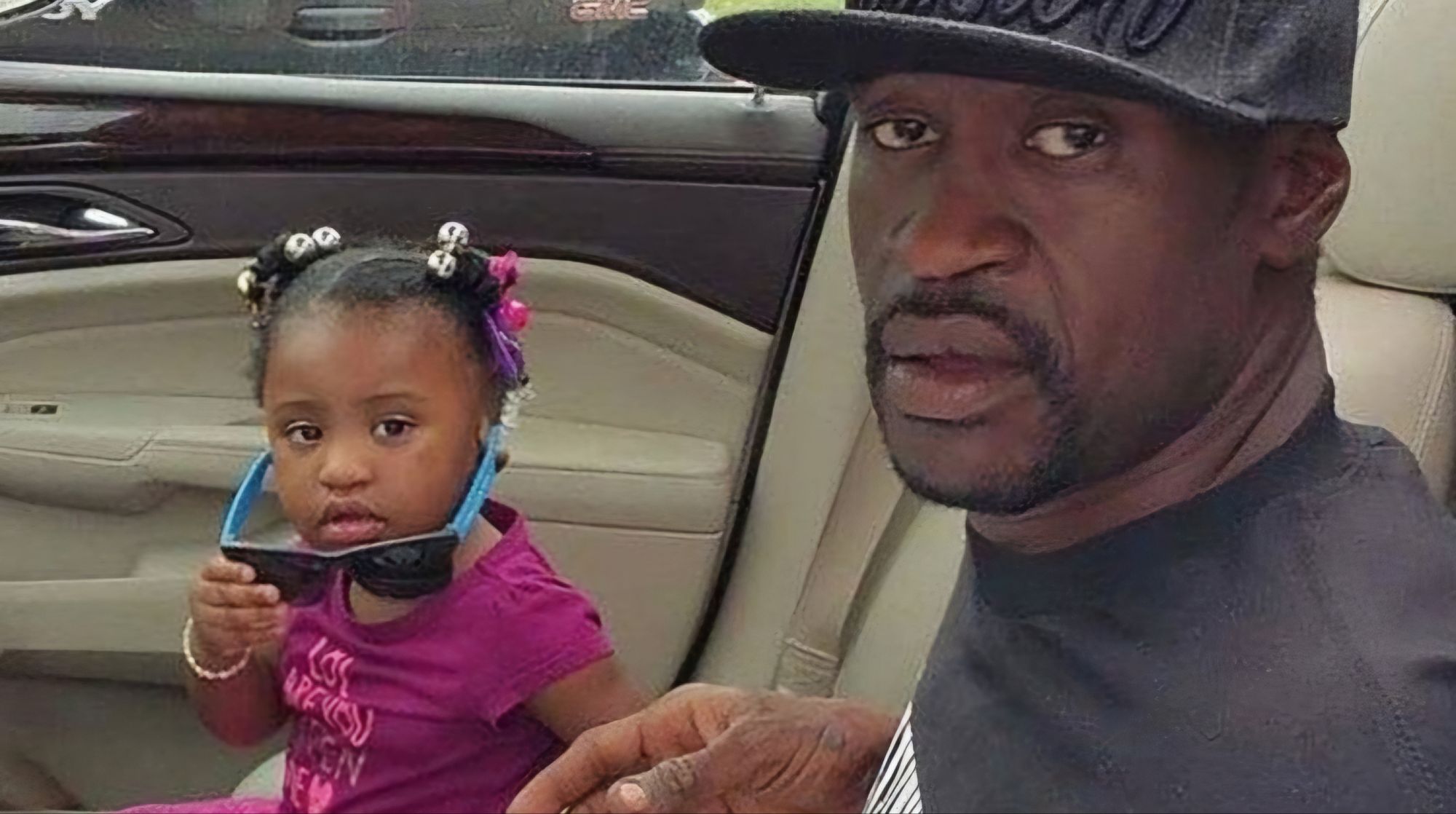
George Floyd and his daughter Gianna | Photo: Ben Crump Law Firm
Here in the UK, BLM got much support – and some opposition. Racists promoted the smug counter-slogan ‘White Lives Matter’ and the more insidious ‘All Lives Matter’.
As a white anti-racist (-Hi!-), I’ve written a long-form blogpost on racism. I added a section about the racist slogan, White Lives Matter.
Whilst updating that section, I looked into what had happened to Black Lives Matter and discovered this tale of the unexpected. I put it in a footnote and then this separate post.
Despite white allyship being controversial, I considered myself a white ally of BLM. Now, I’m not so sure. Next time the badge falls off, I might not put it back.
(Update, June 2022 – the badge fell off. I didn’t put it back on my jacket. Knowing what I know now, I’d feel a fool. I put it on the shelf: a memento of innocent enthusiasm.)
In February 2021the foundation said it gave $21.7m to BLM chapters, and its expenses were $8.4m. That left about $60m unexplained.
In May 2021Patrisse Cullors, one of the three BLM founders, announced she was standing down as executive director of the foundation.
In February 2022 in a UK Guardianinterview*, Cullors tearfully explained she resigned after the movement got black criticism for lack of transparency about the donations.
An April 2022Washington Postcolumn* criticised BLM’s use of its donations, including the secret purchase in 2020 of a $6m house in California.
The WP column drew on an April 2022 investigative article* on New York magazine news website Intelligencer about the BLM house, a 6,500-square-foot compound in Studio City, Los Angeles.
The Intelligencer article is hidden from the hard-up (like me) behind a paywall, but according to WP, it reported a $6m shambles:
BLM said the Studio City house was both a ‘safehouse’ and a place providing:
‘Recording resources and dedicated space for Black creatives to launch content online and in real life focused on abolition, healing justice, urban agriculture and food justice, pop culture, activism, and politics’.
The article said the only content produced there was a few videos made by Cullors for her YouTube channel.
On Twitter, in advance of the Intelligencer report, BLM urged followers:
‘Spread the word: we are redefining what it means to be an activist in this generation with our new Fellowship and Creator House‘.
On Instagram, Cullors said the purchase hadn’t been announced earlier because:
‘The property needed repairs and renovation‘.
In a May 2022AP Newsinterview*, Cullors denied wrongdoing but acknowledged she’d used the Studio City compound for non-BLM purposes, hosting parties to celebrate the inauguration of Joe Biden and Kamala Harris, and her son’s birthday. She said:
I look back at that and think, that probably wasn’t the best idea
* Lest it be suspected these pieces challenging BLM were by racist white hacks, they were all by award-winning black journalists: Nesrin Malik (Guardian), Karen Attiah (Washington Post), Sean Campbell (New York/Intelligencer) and Aaron Morrison (AP News).
There’s more. BLM leaders, friends and family have apparently had large consultancy payouts; and the $6m house was apparently bought from a developer friend who’d recently paid $3m for it.
Sorry – racist white hacks may well have been involved in the sources for the above paragraph: they’re both from the right-wing UK Daily Mail. The Mail refers to revelations in New York Magazine – but that’s behind the pesky paywall.
The impression given by the many articles and comments about all this – and by BLM’s defensive and obfuscatory response – is that BLM is more like a nepotistic cult than a well-run campaign organisation.
However, BLM’s financial irregularities seem a matter of incompetence and mission-drift with a dash of ‘looking after’ people, rather than full-on fraud. Cullorssaid:
Black people in general have a hard time with money. It’s a trigger point for us.
In spite of the irregularities, Black Lives Matter hasn’t quite come apart.
The BLM website gives the impression that all is well. But it’s not – as its mixed-up mission statement shows.
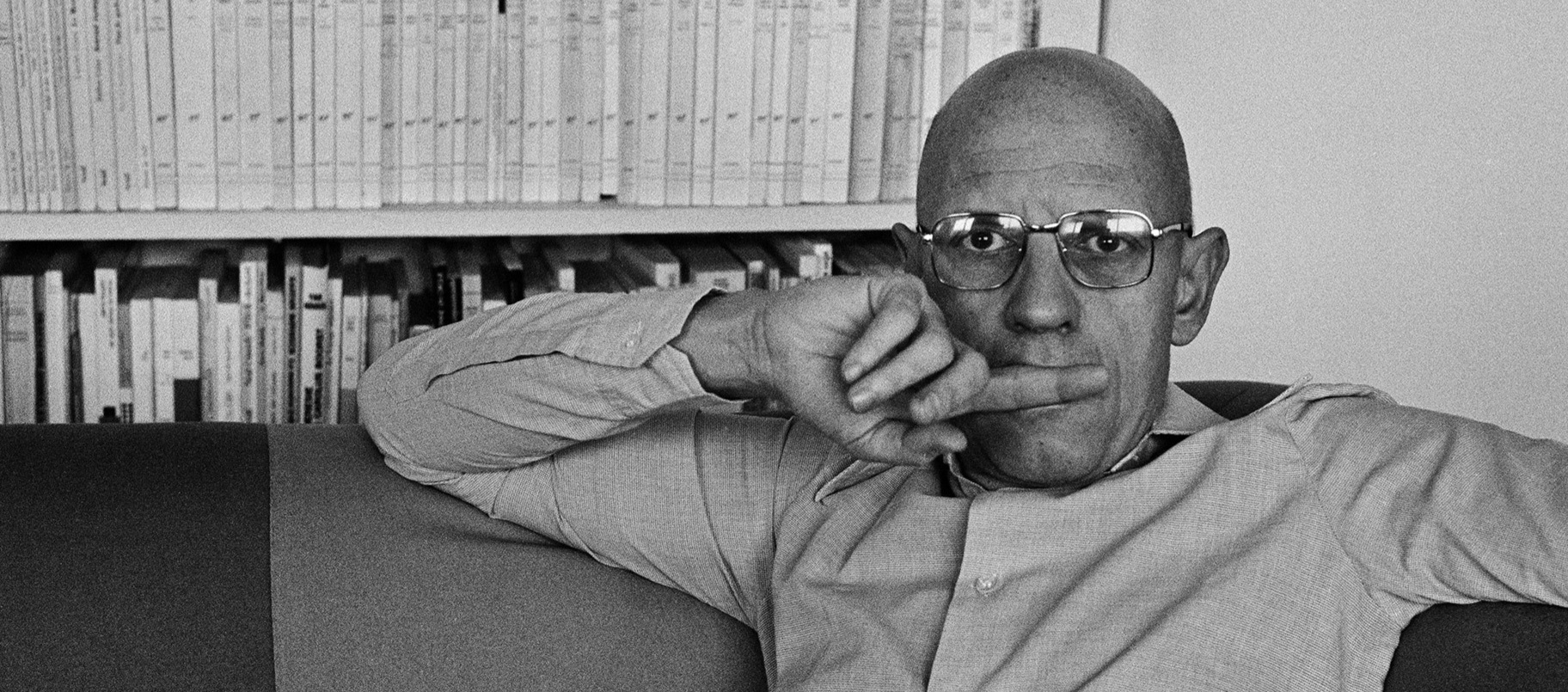
Fun with Foucault – postmodernist Michel Foucault at home in Paris, 1978 | Photo: Martine Franck / Magnum
So what’s Black Lives Matter about? Supporters may have assumed its idea was to oppose racist violence and institutional racism – but it’s more complicated than that.
Eradicate white supremacy and build local power to intervene in violence inflicted on Black communities by the state and vigilantes
So far, so on-point. But the About page then gets more radical:
We affirm the lives of Black queer and trans folks, disabled folks, undocumented folks, folks with records, women, and all Black lives along the gender spectrum. Our network centers those who have been marginalized within Black liberation movements.
There’s more like that: support for black people marginalised in black movements. Fair enough – but is that what the millions of BLM supporters and donors signed up for?
According to a thoughtful 2021National Affairsarticle, BLM’s founders have said their ideology is rooted in postmodern cultural theory. The article said:
A few rabid souls have ferreted out what they regard as the Marxist foundations of BLM. But this gives its prime movers too much credit. BLM has been shaped more by post-modern cultural theory than by Marxism. By their own account, the three young women who ignited this proudly “leaderless” movement have been shaped primarily by feminism and queer theory. Hence their vitriolic critique of the male-dominated black church, not to mention the traditional family.
This analysis evokes the controversial phenomena of intersectional identity politics and critical race theory.
Identity politics enables people of a particular ethnicity or other identifying factor to develop a political agenda based on their identity and their sense of oppression.
Some advocates of identity politics take an intersectional approach, addressing the range of interacting systems of oppression which result from people’s various identities.
Apparently, the complex route from postmodernism to identity politics involved:
Critique of modern reductionism
Abstract universalism
A kind of essentialism
Foucault’s genealogical politics
(Foucault apparently wasn’t the godfather of identity politics. Although he challenged ideas of power structure and championed marginalised groups, he criticised ‘essentialism’ – where groups are defined by fixed characteristics – saying it limited freedom and reinforced inequality. Foucault said, controversially, ‘The self is not given…we have to create ourselves’.)
Our politics evolve from a healthy love for ourselves, our sisters and our community which allows us to continue our struggle and work. This focusing upon our own oppression is embodied in the concept of identity politics. We believe that the most profound and potentially most radical politics come directly out of our own identity, as opposed to working to end somebody else’s oppression.
My bolding
The radical BLM mission statement seems to continue the Combahee River Collective’s theme. BLM co-founder Patrisse Cullors has described herself and her fellow organizers as ‘trained Marxists’. BLM has been sarcastically dubbed ‘Black Lesbian Marxists’.
Critical race theory (CRT) – also a branch of postmodernism – first arose, like identity politics, in the 1970s. According to Wikipedia, it’s:
a cross-disciplinary intellectual and social movement of civil-rights scholars and activists who seek to examine the intersection of race, society, and law in the United States and to challenge mainstream American liberal approaches to racial justice…A key CRT concept is intersectionality
My bolding
In 2022 US conservatives publicly complained about the supposed surge in critical race theory being taught in colleges and universities.
However, an Aljazeera online opinion piece by a US professor said CRT informs BLM and that’s what scares the conservatives:
The significance of Critical Race Theory at this particular juncture in American history is the way a sustained course of the theoretical groundwork now informs … Black Lives Matter. This fruitful dialectic between an academic theory and a grassroots social uprising is what frightens the custodians of the status quo who are fighting tooth and nail to protect and preserve their race and class privileges.
My bolding
That was fine, but perhaps BLM supporters wanted to stop police killing black men rather than have a fruitful dialectic with an academic theory.
Supporters – and donors – might have sympathised with the complex and passionate ideas in BLM’s radical mission statement, but might have been surprised to learn BLM wasn’t the focussed and well-organised campaign against racist murder they – reasonably – expected it to be.
The Black Lives Matter mission, apparently inspired by postmodern intersectional identity politics, made BLM seem more like SnowflakeCity than a campaign coordinator.
Postmodernism critic Ambalavaner Sivanandan | Photo: Jane Bown / The Observer
The ineffectiveness of the Black Lives Matter organisation is – partly, at least – the fault of postmodernism.
Postmodernism is playful, exciting and seductive, but when its theories inform and shape a campaign against racism, it’s a dangerous rabbit hole.
The danger of postmodernism in this context was nailed by the late Ambalavaner Sivanandan, a founder and director of UK anti-racist thinktank the Institute of Race Relations. Sivanandan accused postmodernists of betrayal.
The intellectuals have defected, and walled themselves up behind a new language of privilege… To justify their betrayal, the postmodernists have created a whole new language of their own which allows them to appropriate struggle without engaging in it.
My bolding
Taking on the job abandoned by the treacherous postmodernists, Sivanandan analysed the ‘market’-driven symbiosis of poverty and murderous racism with angry eloquence:
Racism and imperialism work in tandem, and poverty is their handmaiden. And it is that symbiosis between racism and poverty that, under those other imperatives of multinational capitalism, the free market and the enriching of the rich, has come to define the “underclass” of the United States and, increasingly, of Britain and Western Europe… It is there, where the poorest sections of our communities, white and black, scrabble for the leftovers of work, the rubble of slum housing and the dwindling share of welfare, that racism is at its most virulent, its most murderous.
Sivanandan also criticised identity politics as an inward-looking, navel-gazing exercise.
The whole purpose of knowing who we are is not to interpret the world, but to change it. We don’tneed a cultural identity for its own sake, but to make use of the positive aspect of our culture to forge correct alliances and fight the correct battles.
So what’s wrong with postmodernism? In this context, it’s that Black Lives Matter was entrusted to oppose racist murder, but the BLM postmodernist adherents of intersectional identity politics have lacked the necessary focus.
Like the postmodernists despised by Sivanandan, they’ve appropriated the struggle – and $90m in donations – but haven’t effectively engaged in it.
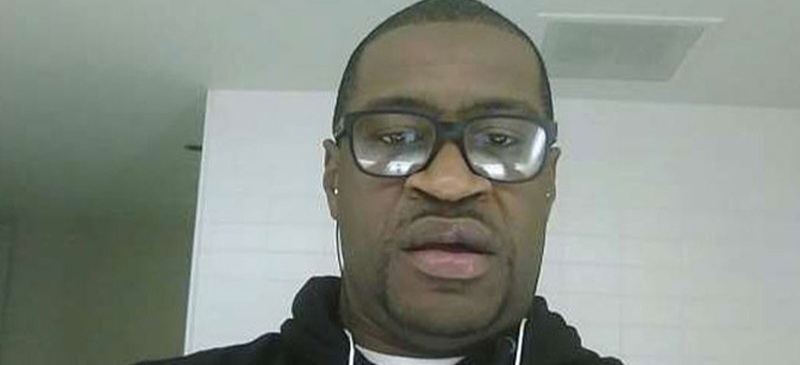
George Floyd: an unarmed black man murdered by the white police | Photo: Ben Crump Law Firm
By May 2022, the Black Lives Matter website gave no hint of any difficulties (except to say it’s a ‘target of disinformation’). However, it continued its mixed message.
On the one hand there was a robust response to US government plans to advance racial justice:
One of the greatest systemic factors affecting the livelihood of Black communities is the continued over-policing, brutalization, and incarceration of our people. Violence by police tears our families apart; leaves emotional, logistical, and financial gaps in our communities; and steals the lives of so many of our loved ones before they get the chance to achieve their dreams. We need the next phase of the action plan to explicitly address how federal agencies will update their policies to hold officers and departments at the local, state, and federal level accountable for the way they engage with Black people.
Healing justice…a portal for revolutionary visions of Black freedom…something we deserve…something we own…something we embody…something each and everyone of us must have. This month our center is ‘Collective Imagination: The Art of Healing Part III.’ We turn our conversation to sacred and luminous practices of creativity and imagination in the healing journeys of Black people. Our healers examine…the multiple ways to access Spirit and wholeness through the individual and collective body. We affirm that healthy connections hold spaciousness for healing and love…sacred healing practices…can support the transformation of individual and collective grief into collective imaginings, futures, and liberation for cultivating sovereignty and co-sovereignty.
* Woo: short for woo-woo, a sarcastic term meaning unconventional beliefs regarded as having little or no scientific basis, especially those relating to spirituality, mysticism, or alternative medicine
The esoteric beliefs expressed in the BLM woo above were presumably meant to benefit activists who felt oppressed because of their intersectional identity.
But such beliefs seemed out of place in a campaign expected by its supporters to concentrate on protecting ordinary black people – Trayvon Martin, George Floyd and many others – from racist murder by state and vigilante enforcers.
What next? Could Black Lives Matter have been saved from disappearing up its postmodern woo-woo arsehole*?
* I’m English – I can’t write ‘asshole’. Sorry 😉
Maybe it just needed organising properly – with mission focus and financial transparency.
Maybe BLM could have kept the spirit of radical activism, but hived off the woo and postmodern cultural theory to a new sister organisation
(Black Snowflakes Matter? A suitable role for Patrisse Cullors, perhaps.)
I asked the Black Lives Matter Global Network Foundation for their comments. They didn’t reply.
Whatever happens with this complicated and troubled organisation, the central Black Lives Matter idea of opposition to racist murder lives on – and still has the reach and momentum to help make racism history.
In June 2022 the Black Lives Matter website announced a ‘Transparency Center‘ which would address some of the issues raised. It said:
We are embracing this moment as an opportunity for celebration, accountability, healing, truth-telling, and transparency. We aim to move forward into this next chapter with the lessons learned, achievements underscored, and a renewed commitment to justice and powerbuilding in service to our community.
The BLM announcement said returns had been filed with the IRS (the US internal revenue service). It said the foundation spent far less on costs than other similar organisations; and went on to say:
An independent audit has revealed that Black Lives Matter’s finances are strong, the organization is financially sound, and its leaders have been good stewards of the people’s donations.
The BLM announcement said the foundation had been fully reimbursed for private events held at the ‘Creator’s House’ (the $6m LA house). It said:
The Creator’s House was purchased as a space of our own, with the intention of providing housing and studio space for recipients of the Black Joy Creators Fellowship in service of Black culture and the movement.
My bolding
(There was an interesting report on the Black Joy Creators Fellowship – a fellowship for black artists and influencers who live in the Creator’s House – by conservative watchdog Capital Research Center.)
The BLM announcement said three new board members ‘with an extensive background in racial justice work’ had been appointed.
That sounded good, but googling showed one of the three had a history of financial delinquency, all three were financially linked through consultancy payments, and all three were connected to BLM co-founder Patrisse Cullors.
Cronyism, mismanagement, consultancy payments – it looked as though nothing much had changed, and the ‘transparency’ was mainly whitewashing. Or should that be blackwashing?
The BLM Transparency Center announcement attacked ‘misinformation from the right wing’, saying:
The right has taken up this cause, hoping to sow mistrust in our work via their media outlets. They have spread misinformation and have taken what is really an important conversation for our community, trashed it, and used their coverage as some sort of validation of their racist allegations. We hope that this is the beginning of a real conversation for our people about the dynamics of our power and our relationship to money.
My bolding
It was disingenuous of BLM to characterise the tsunami of black criticism as a ‘conversation for our community‘ which had been ‘trashed’ by misinformation from the racist right.
The black criticism wasn’t, as the announcement implied, a cosy private conversation. It was a public condemnation which fell on BLM like a ton of bricks. It caused co-founder Cullors to resign.
The racist right put the boot in, of course, but BLM, in portraying the devastating black criticism as a trashed ‘conversation’, was fudging the issue and swerving the criticism.
The BLM transparency centre announcement was mainly disappointing. In 2020 I was an enthusiastic white ally of Black Lives Matter. In 2022, as a critic of BLM, I’d like to have wished the newly would-be-transparent organisation well. But it wasn’t looking good.
Again, I asked the Black Lives Matter Global Network Foundation for their comments. They didn’t reply.
Here comes a snowflake! | photo: Anest / istockphoto
In the UK and the US the traditional left-right two-party political system seems to be running out of steam. Things are fragmenting. Consider the hot potato of identity politics.
Identity politics originated in France, was first applied in America, and has been exported back to Europe. The concept enables people of a particular ethnicity or other identifying factor to develop a political agenda based on their identity and their sense of oppression.
Some advocates of identity politics take an intersectional approach, addressing the range of interacting systems of oppression which result from people’s various identities.
Identity politics emerged in the 1960s and 70s from the hotbed of French postmodernism, which emerged in the 1950s and 60s mainly from the writings of Michel Foucault and Jacques Derrida.
Michel Foucault, Paris, 1978 | Photo: Martine Franck / Magnum
Apparently, the complex route from postmodernism to identity politics included:
Critique of modern reductionism
Abstract universalism
A kind of essentialism
Foucault’s genealogical politics
However, although Foucault challenged ideas of power structure and championed marginalised groups, apparently he’s not the Godfather of identity politics. He criticised ‘essentialism’, where groups are defined by fixed characteristics, saying it can limit freedom and reinforce inequality.
Our politics evolve from a healthy love for ourselves, our sisters and our community which allows us to continue our struggle and work. This focusing upon our own oppression is embodied in the concept of identity politics. We believe that the most profound and potentially most radical politics come directly out of our own identity, as opposed to working to end somebody else’s oppression.
[My bolding]
Liberal critics of identity politics say reaction against its supposedly strident demands contributed to the 2016 US election of populist psycho Donald Trump. Trump voters were said to have voted ‘white’.
Leftist critics of identity politics (eg Ambalavaner Sivanandan) say it’s a distraction from the class struggle. Other critics say the idea fosters inherently wrong or unnecessarily divisive notions of identity, or an unhelpfully exaggerated sense of victimhood.
Some identity politics groups, snarkily dubbed snowflakes, are criticised for being quick to take offence and being vindictive in their ‘cancel culture‘ pursuit of offenders.
Identity politics has been famously dismissed by batty best-selling author and psychologist Jordan Peterson. He echoes fellow bat Ayn Rand (author of Atlas Shrugged) in asserting the primacy of the individual over the group.
Alt-right white supremacists have their very own version of identity politics, ‘identitarianism’, which asserts the right of white people to Western culture and territories claimed to belong exclusively to them. Bless.
The oppression elephant in the identity politics room is racism. Does identity politics address racism? Is there such a thing as black identity politics?
There’s clearly a need for a collective political agenda to challenge the oppression of systemic colour prejudice, but I googled ‘black identity politics’ and got no meaningful results (in the first five pages).
Apparently the hot potato of identity politicsdoesn’t address racism. Perhaps a cooler and less fragmentary political movement is needed for that.
Edit: Sadly – and surprisingly (to me, anyway) – it seems the Black Lives Matter organisation, rather than being the focussed and well-organised campaign supporters and donors might expect, is actually a perfect example of overheated identity politics, and has consequently disappeared down that rabbit hole.
After centuries of previous military incursions, the 1649-53 conquest of Ireland by Protestant mass murdererOliver Cromwell made Ireland a British colony.
The ‘Plantation of Ulster’ consolidated colonialisation. British landowners acquired land in the north of Ireland, mostly stolen from the Irish under 1652 legislation. The new landowners imported English and Scottish tenants and workers as ‘settlers’.
In the 18th and 19th centuries, more British settlers came to the north of Ireland from Scotland, forced out by the theft of land known as the Highland clearances.
ProtestantWilliam of Orange (formerly ruler of the Dutch Republic) had recently become William III of England and Scotland, deposing CatholicJames II in the so-called Glorious Revolution.
James’s ‘Jacobite’Irish army, mostly Catholic, hoped to reinstate James and resolve long-standing grievances about land ownership, religion and civic rights.
The crucial 1690Battle of the Boyne was fought for control of a ford on the River Boyne near Drogheda, north of Dublin. William won.
Having lost the battle and the war, James fled to France. The defeated Irish Jacobites were allowed to practice Catholicism after swearing loyalty to William.
(The 1745Jacobite uprising in Scotland was an attempt by James II’s grandson Charles Stuart, aka Bonnie Prince Charlie, to regain the British throne for his father James, aka the Old Pretender. The uprising collapsed at the 1746 Battle of Culloden.)
After several horrific famines and brutally suppressed rebellions including the 1917Easter Rising when almost 500 people died and 14 were executed, in 1921 the Irish Home Rule movement resulted in the Anglo-Irish Treaty, and Ireland was partitioned.
The main part of Ireland became the Irish Free State, a dominium of the British Empire. Six counties in the northeast chose to stay in the UK, and became known as Northern Ireland.
In 1927, the UK was renamed the United Kingdom of Great Britain and Northern Ireland.
In 1937, following the brief Irish Civil War and its bitter aftermath, the Irish Free State got full independence as Ireland (or Éire). Ireland was officially declared a republic in 1949.
Since the establishment of Northern Ireland in 1921, there’s been constant conflict there between the mostly Protestantunionist majority and the mostly Catholicrepublican minority. Unionists – mostly descendants of English and Scottish‘settlers’ – claim loyalty to the United Kingdom. Republicans – mostly descendants of Irish indigenes – want Northern Ireland to leave the UK and join the Republic of Ireland.
This republican policy, known as unification, is sometimes wrongly called reunification. Ireland’s never been formally unified, so can’t be reunified.
It’s important to get that right – and to distinguish between unionism and unification. It’s not at all confusing. It’s Irish.
In the 1960s, the violent unrest known as the Troubles broke out in Northern Ireland. 30 years of armed conflict between republican and unionist groups and the British army resulted in over 3,000 deaths.
The Troubles ended in 1998 with the Good Friday Agreement, which brought an uneasy but lasting peace.
A power-sharing government was set up: the Northern Ireland Assembly at Stormont in east Belfast. It’s been suspended a number of times. Between 2002 and 2007, Northern Ireland was run from London.
Relations between the two main parties, the Democratic Unionist Party (DUP) and the republican Sinn Féin, broke down again in 2017, and the assembly wasn’t restored until 2020. In 2022 the DUPvetoed the Assembly in protest against the Brexit NI protocol. In 2024 the government was restored.
In 2020, a Northern Irelandopinion poll showed 47% in favour of staying in the UK, and 45% in favour of a united Ireland. (The same poll was run in Ireland: 71% favoured unification.)
On the whole, the rest of the UK couldn’t care less about Northern Ireland – it’s an embarrassing colonial hangover – and NI Protestants, despite their proclaimed ‘loyalism’, couldn’t really care less about the UK – they just want to preserve their postcolonial privileges.
Considering this horrible history, it’d be better and fairer all round if Ireland was unified. Sure, the Protestants would protest, but they’d be fine. They’d be a protected minority – in an EU country, lucky sods.
Unification would, of course, also solve the otherwise intractable Brexit Irish border problem.
Note to Taoiseach: take Northern Ireland – I mean, actually take it, please!
Recently in my workplace I overheard some jokey chat about ‘gingers’. It wasn’t directed at a particular person but I felt uneasy, as I always do when this casual prejudice happens. It felt like a form of racism.
Prejudice against red-haired people, known as gingerism, apparently exists only in England. It’s always framed as jokey banter and is often heard in the workplace or the pub.
If anyone objects, they’re likely to be chided: ‘It’s just a bit of fun. Can’t you take a joke?’ But is it a harmless joke? Or is it actually racism seeking an ‘acceptable’ form?
In the 1950s and 60s, racist comments were commonplace in the workplace and the pub, but now they’re unacceptable in public. Perhaps ‘harmless’ jokes about red-haired people or about the Welsh, (another similarly mocked group) constitute a new outlet for the redundant but dangerous and destructive anti-stranger instinct upon which racism is apparently built.
A UK Guardian article on the subject downplayed the idea of gingerism as racism, pointing out that people with red hair clearly don’t suffer the same devastating personal and institutional discrimination as people with black or brown skin.
However, the Guardian article suggested an interesting explanation for gingerism: English anti-Celtism, and – more specifically – anti-Irish feeling.
Many Irish people have red hair. Since Cromwell’s brutal colonisation of ireland, there’s been a tendency for the English to disdain the Irish. (Hence Irish ‘jokes’.)
In the 1950s, London boarding-house signs supposedly said, ‘No blacks, no dogs, no Irish‘. This seems to be apocryphal, but it illustrates a real prejudice.
English red-haired people bravely (Brave!) try to reappropriate the word ‘ginger’ – as African Americans have reappropriated the N-word. But the bullying ‘jokes’ continue regardless.
Red-haired Neanderthals
Neanderthal humans had red hair. Having lived in Europe for over 100,000 years, they were apparently wiped out 35,000 years ago by immigrating early modern humans. (Early modern humans emigrated everywhere – they’re the ancestors of all humans.)
Perhaps ‘jokey’ bullying of red-haired people and colonialist anti-Irish sentiments are echoes of that ancient hostility.
(As well as killing Neanderthals, early humans interbred with them. Most Europeans and Asians have 1-4% Neanderthal DNA. However, red hair in modern humans isn’t inherited from Neanderthals – apparently it’s a different gene.)
I’ve always greatly respected the Enlightenment, the European intellectual movement of the 17th and 18th centuries led by philosophers such as Descartes, Locke, Newton, Kant, Goethe, Voltaire, Rousseau, and Adam Smith.
(I’ve read about them…)
The Enlightenment emphasised reason. I’d looked up to it as a way out of superstition, ignorance and oppression, and as the foundation of modern liberal democracy.
However, the Black Lives Matter movement has exposed the part played by Enlightenment philosophers in justifying the slave trade and slavery by coming up with the idea of white supremacy.
I didn’t know, for instance, that Immanuel Kant said, ‘humanity is at its greatest perfection in the race of the whites’. To be fair, he apparently later recanted (re-Kanted?), kind of, but the damage was done.
Kant, the hypocritical preacher of moral egalitarianism, expounded at length about the failings of the various ‘races’ as compared with the perfect whites. He said black people were stupid. He babbled authoritatively about the qualities of different African ‘races’ in terms of their suitability as slaves.
Such ‘philosophy’ was extremely useful to slave traders and ‘owners’ – not in practical terms, but in terms of moral support for their inhuman enterprise.
Now we know about the Enlightenment’s dark side, and in the woke wake of that awareness students have – understandably – called for decolonisation of the university syllabus. (The Daily Mail‘s response: ‘They Kant be serious!’)
In defence of the Enlightenment, it’s said that Kant & co. were conservative, and we should look to lesser-known radical philosophers of the Enlightenment – Baruch Spinoza, for instance – for its heart and soul.
Maybe so, but those mainstream conservative Enlightenment philosophers built our foundations – which now feel shaky.
Luckily – switch of metaphor! – the fruit of the Enlightenment, liberal democracy (currently the worst form of government apart from all the others) seems not fundamentally poisoned by this racist root. So I’ll still praise the Enlightenment – but less wholeheartedly.
The poison wasn’t Enlightenment philosophy – it was colonialism. It’d be nice to think those two heavyweight phenomena – Enlightenment and colonialism – were fundamentally separate and coincidental, rather than horribly symbiotic.
We need to decolonise our democracy but it’s easier said than done. Having ripped off and destroyed colonial countries, the UK blithely invited large numbers of residents of those countries to move and live here to help rebuild postwar Britain – then blighted their lives with postcolonial racism.
As I argue elsewhere, colonial racism is apparently a twisted version of a redundant anti-stranger instinct (evolved to protect against communicable disease).
If we acknowledge that, we can choose to live above it (as with other ‘monsters from the id‘), so enabling us to oppose and end racism and to decolonise our minds – and our institutions.
I was scolded on a local Facebook page for criticizing the phrase ‘mixed race’. The scolder said: ‘I’m mixed race – that’s what I call myself.’ ‘Yes, but…’ I thought.
Meghan Markle, aka Duchess of Sussex | Photo: Shutterstock
Here in the UK, people have their ethnicity labelled, like it or not. But the phrase ‘mixed-race’ is loaded with prejudice. Isn’t it?
We’re asked to tick a box for our ethnic identity on forms gathering data for marketing or discrimination-monitoring purposes. The UK police use ethnic identity codes to describe suspects. The UK census asks, ‘What is your ethnic group?’
People of colour might, on the one hand, see such labelling as a form of racism. On the other hand, the concept of ethnicity allows people of colour to identify themselves – in positive terms.
Either way, ethnic identification is here to stay. So… is it OK to say ‘mixed-race‘? No. How can it be OK to say ‘mixed-race‘ when ‘race‘ is known to be a false category cooked up by white supremacists with fake science?
But… the phrase ‘mixed-race‘ is in widespread use by both white people and people of colour. In that context, race is supposedly a neutral ‘social construct‘ that simply describes the different human populations.
Even the Guardian (centre-left, the UK’s only national daily newspaper not owned by billionaires) uses ‘mixed race‘ to describe, for instance, Meghan Markle. (The usually brilliant Guardian style guide is silent on the subject.)
When ‘mixed-race’ is used in a social-construct sense, the toxicity of the word ‘race‘ is somehow shut out. The vile supremacist ideology scratches at the door, but is just ignored. The usage may be considered harmless but it carries the baggage of slavery.
As a zealous and pedanticantiracist, I objected to the use of the phrase on a local Facebook page and got a hostile response. People said, ‘I’m mixed-race – that’s what I call myself’.
But why would anyone accept ‘mixed-race‘ as a description of themselves, loaded as it is with outmoded prejudice?
Which words are acceptable alternatives to ‘race’? Ethnicity? Heritage? Ancestry?
‘Race’ is used in what’s meant to be a neutral social-construct sense to describe the different human populations. But the supposed neutrality of that context doesn’t mask the word’s stench of bigotry. An alternative to the toxic word ‘race’ is needed.
Ethnicity
The UK governmentstyle guide recommends the word ‘ethnicity’:
We refer to ethnicity and not race…We don’t say ‘mixed people’ or ‘mixed race people’. We usually say ‘people with a mixed ethnic background’…
‘Ethnicity’ is an awkward mouthful of a word, and might seem blunt. But its meaning is clear – and it’s neutral.
The UK census uses the phrase ‘ethnic group‘. It quacks like a nerdy Dalek, ‘What is your ethnic group?’
Under ‘Mixed or multiple ethnic groups’, the UK census lists several options, including write-it-yourself in 18 characters or less (good luck with quadruple ethnicity):
(The insensitive Dalek means well. UK public services being mainly multicultural, the data can shape progressive policy.)
Heritage
The government guide and the census don’t use the word ‘heritage‘ – perhaps partly because there’s a connotation problem.
‘Heritage‘ could sound like something to do with the National Trust collection of stately homes – many of which, according to a 2020 NT report, have links to the slave trade and colonialism.
But ‘heritage’ has some merit as an alternative to ‘race’. ‘Mixed heritage‘ is a syllable shorter than ‘mixed ethnicity‘; and ‘heritage’ is easier to say than ‘ethnicity’, lacking that awkward ‘thn‘ sound.
Also, ‘heritage‘ sounds less personal and direct than ‘ethnicity‘. ‘Your heritage‘ sounds more discrete and less intrusive than ‘your ethnicity‘.
And when addressing someone’s cultural background, ‘heritage’ is more meaningful than ethnicity.
Note: The notion of cultural heritage might not be as innocuous as it sounds. Perhaps racism is boosted by culturism, in that the ‘strangerness’ of people of African or Asian ethnicity living in the west indicates a different culture. That cultural difference – perhaps perceived unconsciously – might elicit fear and prejudice in the ignorant.
Ancestry
Then there’s ‘ancestry‘, which is acceptable if the context is understood.
So…
‘Heritage‘ and ‘ancestry‘ are useful non-toxic alternatives to ‘race‘ and they’re less direct than ‘ethnicity‘. But they’re ambiguous and euphemistic. We’ve all got mixed heritage and ancestry – but we haven’t all got mixed ethnicity.
So – with some reservation – I’ll mainly use ‘ethnicity‘ in this post – it’s more meaningful.
If you have more than one ethnic identity, would you want to say how many? If so, how would you say it – and when?
Some people describe themselves as having dual ethnicity. They want people to be aware of the challenges and benefits of having two different ethnic backgrounds.
That’s understandable. But ‘dual ethnicity‘ or the occasionaly used ‘biracial‘ – which includes that word – can be seen as pointlessly limiting, like the horrible ‘half-caste‘ (which leads to a hell-hole of outdated racist numerical classifications such as ‘quadroon‘).
What if you have more than two ethnicities? If, say, one of your parents has African ethnicity and the other parent has dual South Asian and European ethnicity, would you say you have triple ethnicity (or you’re triracial)?
What if your parents have four ethnicities? It’s increasingly possible: say, East Asian, South Asian, African and European. Would you say you have quadruple ethnicity? (It sounds a bit like ‘quadroon’…)
‘Mixed ethnicity‘ is discreet and flexible, giving enough information without a number. It says, in effect:
As you may infer from my facial appearance, I have more than one ethnic identity and that’s an important part of my character. I’ll give more information if and when it’s appropriate.
Ethnic identity is used negatively by racists. But it’s used positively by people of colour – and usefully by public services such as the census and the police.
Racists use ethnic identity negatively to assert their imagined superiority.
However, people of colour identify themselves positively as, for instance, black British, Asian British or mixed ethnicity, thereby identifying their family origins, the colour of their skin, and their cultural allegiances.
The UK censususefully records ethnicity statistics which can help shape progressive policies.
And apparent ethnicity can be useful to describe an unknown person. In the Facebook incident that prompted this post, a man harassing women in a park was described as ‘mixed-race‘.
The UK police use radio shorthand identification codes, known – tautologically – as IC codes, to describe suspects to colleagues. For instance, IC3 stands for black, IC4 for South Asian and IC5 for East Asian.
There’s no IC code for people whose appearance indicates mixed ethnicity. However, IC7 means unknown.
During ‘stop and search’ operations, police use more complex ‘self-defined ethnicity‘ codes. People stopped are asked to choose one of 18 codes. The codes follow census categories (see above) by including options for mixed ethnicity.
(Although such ‘racial profiling‘ is useful to the police, it’s also abused by them. For instance, the controversial practice of stop and search is overused against young black men by a force repeatedly said to be institutionally racist.)
Science-denying racists say there are different human races, some of which are intrinsically superior to others. They’re wrong.
Pseudo-scientific racists, from Enlightenment philosophers (eg Kant and Locke) onwards, tried to justify colonialism and slavery by claiming Europeans are inherently more intelligent than other ‘races‘. They aren’t.
Taxonomically, all modern humans are Homo sapiens (the only surviving species of the genus Homo).
Race is a slippery concept, but in biology it’s an informal rank below the level of subspecies, the members of which are significantly distinct from other members of the subspecies.
Genetic research has confirmed the obvious: apart from some ‘single-gene’ disorders*, the differences that evolved between different human populations, albeit visually and culturally obvious, are not significantly distinct. This means the different populations are not races in any scientifically meaningful sense.
There are no different human races, just human populations – which are becoming increasingly mixed.
White racists, of course, don’t care if there are scientifically meaningful races or not. They just indulge in bullying prejudice against people of colour. The disused phrase, ‘colour prejudice’ is more linguistically meaningful than ‘racism’.
* Single gene disorder: genetic disease caused by a mutation in a single gene.
Some single-gene disorders are specific for certain populations, like Tay-Sachs disease among Ashkenazi Jews, cystic fibrosis in Caucasians, thalassemias among people from Southeast Asia and the Mediterranean countries, and sickle cell disease in people of Western African origin.
The different human populations are becoming mixed. The historical causes are bad but the mixing is good.
Increased travel in recent centuries brought large numbers of people of different appearance face to face for the first time in human history. Unfortunately, most of that contact was colonial.
The consequent vile transatlantic slave trade and carelessly engineered postwar mass immigration resulted in black and white people living in the same country. Inevitably, in spite of racism and conflict, they’ve mixed.
Before pseudo-scientific racism was rumbled, racists sneered about ‘miscegenation‘; and amongst ethnic minorities there’s pressure to resist assimilation and preserve cultural heritage by not ‘marrying out’.
But – some dodgy lyrics aside – Blue Mink were right: what we need is a great big melting pot. Marrying ‘out’ doesn’t have to mean loss of cultural heritage – it can be seen as marrying in.
Ethnicity is often related to religion, and there may be concern that marrying ‘out’ will dilute religion and therefore morality. But here in the western melting pot, we live in a post-religious age. God – as the source of morality – is dead.
Fortunately, as social animals we have innate goodness – and any innate badness can be constrained by the rule of law, preferably under liberal democracy (the worst form of government apart from all the others).
(Non-religious spirituality, on the other hand, is alive and well – and isn’t affected by inter-ethnic mingling.)
People say ‘race’ is a ‘social construct’. But the word ‘race’ is still toxic, and the abstract idea of a ‘social construct’ can be misunderstood – and misused.
Science shows there are no human races, but some say ‘race’ is a social construct which doesn’t have to be scientifically meaningful – it’s just a way of describing the different human populations.
A social construct is said to be a concept or category that exists due to shared agreement within a society, rather than being based on objective reality.
‘Race‘ as a social construct is used by non-racists as shorthand for populations of different ethnicity. It’s used in that way in speech by people of colour; and by both black and white writers and speakers in non-racist media. For instance, the liberal, antiracist UK Guardian happily describes Meghan Markle as ‘mixed race’.
But devious racists use the social construct idea to blur the issue and keep talking about ‘race‘ despite the evidence there are no races. Confusion between ethnicity and race is the loophole in the social construct through which racists can slip.
The social construct idea has complex theoretical academic origins. Not everyone gets it. Many people reading or hearing the word ‘race’ in the media, unaware of any ‘shared agreement’ about what it means, might understandably assume it refers to an objective reality and means what it says.
Many people reading or hearing the word ‘race’ will think – and will be encouraged to do so by loophole racists – it means what it meant in the days of empire, slavery and Holocaust, when ‘races’, identified by appearance or culture (or both), were ranked in order of superiority, with white at the top and black at the bottom.
Despite its frequent use by non-racists as – supposedly – a social construct, the word ‘race‘ is fundamentally toxic and redundant. For antiracists, the solution to this linguistic dilemma is to abandon the flimsy social construct context and stop using the word ‘race‘.
(‘Race‘ is, of course, implied in the word ‘racism‘ but until the misnamed thing ends, the word will probably continue to be used, trailing its toxic root.)
Some black antiracist campaigners say mixed-ethnicity people should identify as black – but how can it be right to deny part of your ethnic identity?
Some radical black antiracists say: ‘If you’re not white, you’re black.’ They’re saying people of mixed ethnicity should identify solely as black (meaning non-white, ie black or brown).
One such proponent was prominent black UK broadcaster and antiracist campaigner, the late Darcus Howe. Fellow activist Sunder Katwala has recalled being on the receiving end of Howe’s rhetoric.
Katwala, the mixed-ethnicity director of immigration think-tank British Future, wrote about the encounter in the conclusion to his 2012 BF report The Melting Pot Generation.
Katwala and Howe were chatting after a TV discussion (about a controversial remark made by a black politician). Katwala apparently referred to himself as ‘mixed-race’, and Howe objected. Katwala:
“Mixed race? What’s all this mixed race nonsense? If you’re not white, you’re black.”
That old point was jovially roared at me with some emphasis by one of this country’s leading public raconteurs on race and racism.
“But I’ve never thought I was black. Shouldn’t it be up to me to decide?”
“What are you then?”
“British. And English. My parents are from India and Ireland, so I’m half-Asian and mixed race as well.”
“British? Why don’t you call yourself Indian? Are you ashamed of your father, boy?”
Howe was forcefully expressing the well-known position of radical antiracism: ‘mixed‘ is nonsense – if you’re not white, you’re black.
It’s an understandably angry political response to mixed-ethnicity people experiencing racism because they’re not white.
It’s a proud and noble gesture. But should people of mixed ethnicity feel obliged to deny a significant part of their cultural heritage? Isn’t the antiracist cause best served by people of colour feeling free to express their full identity?
Note: I came across the story about Howe and Katwala in a 2021 Conversationarticle by mixed-ethnicity author and academic Remi Adekoya. The article, Biracial Britain: why mixed-race people must be able to decide their own identity, was based on Adekoya’s groundbreaking 2021 book:Biracial Britain: What it means to be mixed race.
Some mixed-ethnicity people call themselves ‘mixed-race’. It’s easy to say – and difficult to criticise.
Some people of mixed ethnicity say:
‘I’m mixed-race – that’s what I call myself. Don’t tell me what to say!’
It must be difficult enough being brown-skinned in a white world – facing microracism (‘Where are you from?’) and conscious and unconscious personal and institutional bias – without having a would-be white saviour (I’m white, by the way – Hi!) tell you how you should or shouldn’t describe yourself.
Whitesplaining word-nerd virtue-signaller – who do I think I am? It’s like a white person telling black Americans not to use the N-word: ‘I say, you rapper chappies – you really shouldn’t use that bad word.’
Except it’s not like that. When a mixed-ethnicity person uses the phrase ‘mixed-race‘ to describe themselves, they’re not re-appropriating the word ‘race‘ in a playfully political way.
They’re giving white people permission to use that phrase – and they’re inadvertently agreeing with zealous racists, the only people who think there actually aredifferent races.
The question remains: why would anyone choose ‘mixed-race‘ as a description of themselves, knowing it to be loaded with outmoded prejudice?
Maybe mixed-ethnicity people call themselves ‘mixed-race‘, thinking, ‘So what? Who cares? It’s a social construct. It’s just what people say. And it’s only two syllables.’
Maybe they’re winding up mitherers like me. If so, damn – you got me!
I just hope it’s not an example of that depressing phenomenon, internalised racism.
‘Mixed race’ is easy to say and ‘race’ is now supposedly a neutral social construct. But shouldn’t that toxic word be retired?
Some people choose to describe themselves as ‘mixed-race‘. The word ‘race‘ has ugly roots but when it’s understood as a social construct rather than a fake biological category perhaps it seems better than the non-toxic alternatives.
The main alternative, ‘ethnicity‘, isn’t an easy word. Although it’s harmless and clear in meaning, it’s a difficult, official-sounding word. It doesn’t roll off the tongue easily – it’s definitely not a people’s word.
But in spite of that, ‘ethnicity‘ is still better than ‘race‘, isn’t it? The phrase ‘mixed race‘ is easy to say but even in a social-construct context it remains loaded with fake science and colonial notions of white superiority.
Shouldn’t the word ‘race’ be left in the shameful past where it belongs?
‘Mixed ethnicity‘ is a mouthful. It’s got academic roots, three extra syllables and an awkward ‘thn‘ sound. But it avoids that toxic word and in its neutral clarity it celebrates our differences and embraces their mixing.
A casual phrase in use is ‘mixed ethnic’. It’s easier to say someone is ‘mixed ethnic’ rather than saying they have ‘mixed ethnicity’, but when applied to a person, the casual abbreviation ‘ethnic’ might – understandably – be considered offensive.
A commenter on this post (see below) points out that young people of mixed ethnicity tend to refer to themselves simply as ‘mixed‘.
That’s a cool solution. When used in context, the abbreviation ‘mixed‘ keeps the meaning while avoiding bothuncool words: ‘race‘ and ‘ethnicity‘.
For older people (like me) the – less cool – solution is:
There’s a large park near us with deer in it. I’m an anti-hunting vegetarian, but whilst walking there recently, I felt an atavistic urge to hunt the deer!
Kill Bambi! | Photo: Christopher Day
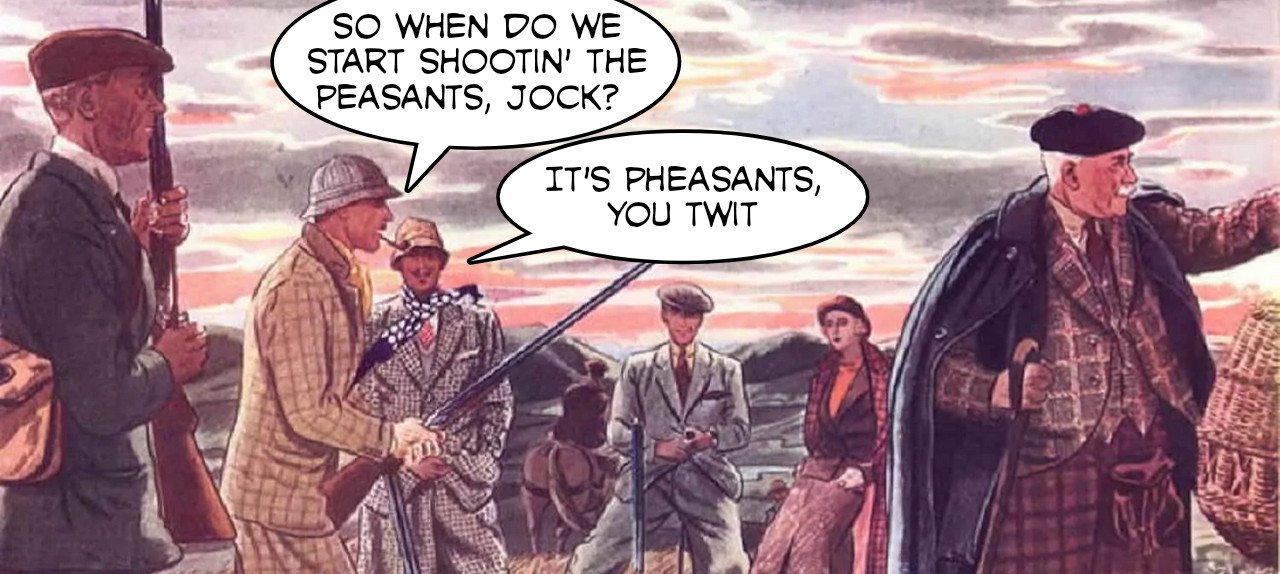
Here in the UK, we churlish peasants hate the landed aristocracy (and the nouveaux super-rich), not least for their hobbies of huntin’, shootin’ an’ fishin’. (The dropped end-consonant is an aristo affectation.)
However, putting aside class hatred, maybe that’s what we’d all do if we had their time and money (although perhaps not in pursuit of the inedible fox, UK aristos’ favourite quarry). Maybe it’s intrinsically enjoyable. Maybe it goes back to hunting and gathering.
Putting aside – also – our modern vegetarian sensibilities, maybe hunting and gathering was sociable and enjoyable. Then we invented farming, which was antisocial and boring. (Perhaps nomadic herding is an acceptable intermediate lifestyle.)
After the Norman invasion of England in 1066, the victors stole all the land. They hunted in their forests. No one else could. (Perhaps poaching was semi-tolerated as a safety valve. Huntin’ an’ poachin’!)
So in the future (having somehow survived the climate crisis), with aristos and the super-rich all exiled to the moon (for receiving stolen land and criminal damage to the environment), and with reformed money, a state income, most work automated, food produced hydroponically and the land commonised and rewilded, we can all enjoy some occasional recreational huntin’ an’ gatherin’.
Then, at the end of the day, it’s back to the tribal eco-cave for an evening of eating, drinking, story-telling and singing around the fire. (Finally, drunk as skunks, it’s back by autodrone to our ecopods.)
Back in the album-listening 60s and 70s I vaguely wondered through the stoned haze how come I was hearing that unusual line, ‘We’re all (or We are) normal and we want our freedom‘, in two different songs on albums by two very different artists.
Decades later, I finally looked it up. The line’s from Marat/Sade, the famous 1963 play by Peter Weiss. The play’s full title is:
The Persecution and Assassination of Jean-Paul Marat as Performed by the Inmates of the Asylum of Charenton Under the Direction of the Marquis de Sade
Set in 1808 in the Paris asylum in which the notorious Marquis de Sade was incarcerated in real life, the play features de Sade staging a (fictional) play-within-a-play about the (real-life) murder of Jean-Paul Marat, using his fellow inmates as actors. In Act 1, Scene 6, the inmates chant:
We’re all normal and we want our freedom!
The play, said to draw on the ideas of Bertold Brecht and Antonin Artaud, was directed for theatre and film by theatre god Peter Brook. His award-winning production reportedly shocked audiences.
In 1967 Love’s Arthur Lee must have seen Marat/Sade and borrowed that line for The Red Telephone.
Then in 1968 The Bonzo Dog Doo-Dah Band’s Viv Stanshall must – coincidentally – have done the same thing for We Are Normal. Or perhaps he borrowed the line from Lee’s song.
A relatively meaningless stand-in title, apparently
The wistful and melancholic song The Red Telephone on Love’s brilliant and timeless 1967 album Forever Changes was written by Arthur Lee.
According to Love forum contributor and music writer Mike Shaw, Lee moved in 1966 to a house in Laurel Canyon, the Los Angeles area renowned in the 60s and 70s for its community of folk-rock musicians.
The house (which featured in Roger Corman’s 1967 film The Trip*, starring Peter Fonda and Dennis Hopper, written by Jack Nicholson) has a panoramic view over LA.
* The Trip also starred Salli Sachse, later to inspire Jackson Browne’s song Something Fine (on his eponymous debut album) whilst having a brief affair in London with him shortly before his notorious 1972 affair with Joni Mitchell. In Laurel Canyon.
View over LA from Laurel Canyon | Photo: John UmrevilleDetail of poster for The Trip | American International Picture
Lee wrote The Red Telephone there. Regarding the gloomy opening line, ‘Sitting on a hillside, watching all the people die’, Shaw imagines Lee hearing ambulance and police sirens in the distance as he gazed down at the city.
In 1967, the Marat/Sade film was showing in the US (and there was a much-praised Broadway theatre production in New York). In LA, Lee must have seen the film and borrowed the Marat/Sade line for The Red Telephone.
Near the end, The Red Telephone (echoing the style and rhythm of the 1966 novelty hit They’re Coming to Take Me Away, Ha-Haaa! by Jerry Samuels, aka Napolean XIV) segues into an ominous marching chant, repeated several times:
They’re locking them up today
They’re throwing away the key
I wonder who it’ll be tomorrow, you or me?
Lee then gives a plaintive spoken rendition of the Marat/Sade line:
The wierd and wonderful song We Are Normal on the Bonzo’s brilliant and bonkers 1968 album The Doughnut in Granny’s Greenhouse was written by Viv Stanshall and fellow Bonzo Neil Innes.
During the recording of Doughnut, Dadaist Stanshall, wearing a rabbit’s head and underpants, interviewed passers-by in a nearby London street. On We Are Normal, an interviewee is heard saying, ‘He’s got a head on him like a rabbit.’
Stanshall apparently said they got the ‘normal’ line from Love’s song. Innes has said they got it from Marat/Sade (the theatre and film versions of which were on in London in 1968). Perhaps they got it from both sources.
The Bonzo’s We Are Normal is part sound experiment with cut-up vox pop and Miles-like trumpet, and part cod heavy rock. The only lyric is a close paraphrase of the Marat/Sade line, sung repeatedly and assertively in the rock section:
We are normal and we want our freedom!
Stanshall slips in a cracking rhyme: ‘We are normal and we digBert Weedon‘ – but he adds a sarcastic laugh, as if to say although he couldn’t resist the joke, such humour was out of place in a serious experimental artwork.
Sadly, both geniuses died prematurely. Viv Stanshall died aged 51 in 1995 when an electrical fire broke out as he slept. Arthur Lee died of leukemia aged 61 in 2006.
Update, 2023: Typically, Stanshall left a chaotic legacy of unfinished work which only now, 18 years after his death, has born fruit.















 soothfairy